
How to Get Your Bladder Back on Track in Idaho
Bladder Leaks Are Not Something You Just Have to Live With
If you are looking for idaho urinary incontinence help, here is what you need to know right away:
Quick Answer: Where to Find Urinary Incontinence Help in Idaho
Non-invasive treatment (HIFEM electromagnetic therapy + acupuncture): Boise Better Bladder, Boise, ID
Pelvic floor physical therapy: Available in Boise, Nampa, and Idaho Falls
Urogynecology clinics: Idaho Falls and Boise (surgical and non-surgical options)
Urology specialists: Boise, Meridian, Nampa, and Coeur d'Alene
Overactive bladder clinics: Treasure Valley (Boise/Meridian area)
You are not alone in this. Urinary incontinence affects as many as 45% of adult women - and yet approximately 75% of women with bladder leakage never discuss it with their healthcare provider. Many quietly manage with pads, limit their activities, or simply accept it as an unavoidable part of getting older. For a broader medical overview of bladder control problems in women, the National Institute of Diabetes and Digestive and Kidney Diseases offers a helpful patient resource on bladder control problems in women.
It is not.
Bladder leaks are a signal. They are your body communicating that something in the underlying system - the muscles, the nerves, the structural support - needs attention. That is very different from something being permanently broken or beyond help.
Whether your symptoms started after childbirth, worsened around menopause, or have gradually crept into your daily life over the years, there are real, effective, and non-invasive pathways to restoring control.
Symptoms are signals. And signals can be addressed.
I'm Dr. Kimberly Thompson, DACM, L.Ac., and I have spent years working with women throughout Idaho who were searching for idaho urinary incontinence help after feeling frustrated or dismissed by conventional approaches. Through an integrative method combining advanced HIFEM technology with acupuncture and holistic care, I help women address the root causes of bladder dysfunction - not just the symptoms. In this guide, I will walk you through everything you need to understand about why this happens and what actually works.
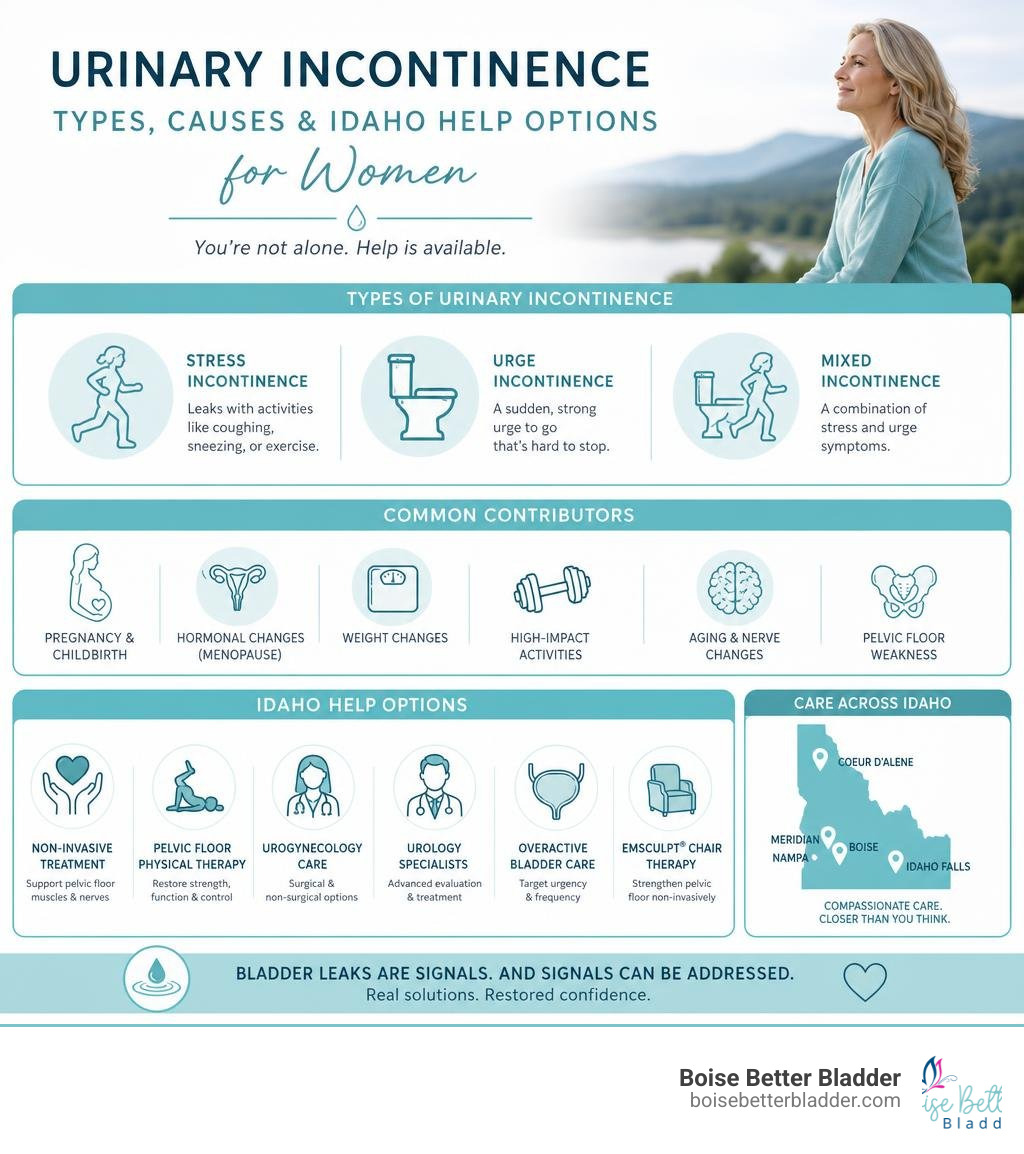
Finding Idaho Urinary Incontinence Help: Understanding Your Body's Signals
When women begin experiencing bladder leaks, the most common piece of advice they receive is simply to "do more Kegels." If that does not work, they are often told that their bladder is just "weak" or that their pelvic floor has "failed."
This explanation is incomplete.
Your pelvic floor is not a single muscle acting in isolation; it is a sophisticated, dynamic hammock of muscles, ligaments, and connective tissues that support your pelvic organs. Furthermore, these muscles do not operate on their own. They rely on constant, rapid communication with your nervous system.
When you experience urinary leakage, it is rarely just a matter of "weakness." Instead, it is often a breakdown in coordination, tissue resilience, or neurological signaling.
“Your body isn’t failing you.”
Instead, your body is adapting to changes. When we look for sustainable idaho urinary incontinence help, our first step is to decode the patterns behind these changes.
During a clinical consultation, we look at the whole picture. We evaluate when the leaks occur, what triggers them, and how your pelvic nerves communicate with your brain. Standard diagnostic pathways in traditional clinical settings may include:
A detailed medical history: Reviewing pregnancies, births, surgeries, and hormonal transitions.
Symptom tracking: Keeping a bladder diary to monitor fluid intake, trigger times, and leakage frequency.
Physical assessments: Evaluating muscle tone, tissue integrity, and checking for anatomical shifts.
Functional testing: Simple, non-invasive evaluations like a cough test or an at-home pad test to measure the physical impact of daily movement on your bladder support.
By understanding these signals, we can move away from temporary fixes and toward true restoration. You can read more about this approach in our guide on Understanding Weak Pelvic Floor Treatment.

Why Traditional Idaho Urinary Incontinence Help Often Falls Short
For decades, the conventional approach to bladder control has relied on a predictable sequence: pads, pills, or surgical procedures. While these options may be necessary for some, they often fall short of providing a long-term, comfortable solution.
Pads and protective garments are passive management strategies. They do not treat the underlying issue, and they come with a significant financial and emotional cost. On average, women with severe urinary incontinence pay $900 annually for routine incontinence care items like pads and liners.
Pharmaceutical options, such as medications for overactive bladder, often attempt to block nerve signals to stop bladder spasms. However, many women find that the side effects—such as chronic dry mouth, constipation, and blurred vision—are difficult to tolerate. Furthermore, medications do nothing to restore the structural strength of your pelvic floor.
Surgical interventions, such as synthetic mesh slings, aim to physically support the urethra. While they can be highly effective for pure anatomical stress leaks, they are invasive procedures. They carry risks of mesh erosion, infection, and chronic pain, and typically require a recovery period of at least six weeks, during which you must avoid heavy lifting and intercourse. Additionally, surgery does not address the hormonal shifts of aging or menopause that continuously affect tissue elasticity. For women experiencing these hormonal transitions, understanding how estrogen drops affect the bladder is crucial; you can explore this further in our article on Menopause Bladder Issues.
The Connection Between Pelvic Organ Prolapse and Bladder Leaks
To understand why bladder leaks happen, we must also understand pelvic organ prolapse. The pelvic floor organs—including your bladder, uterus, vagina, small bowel, and rectum—are held in place by a network of muscles and connective tissues.
If this support system becomes compromised, these organs can begin to descend or droop. This condition is known as pelvic organ prolapse, and it is incredibly common. In fact, about one-third of all women are affected by prolapse or similar pelvic floor conditions over their lifetime.
The levator ani muscle is the primary muscle group responsible for keeping these organs lifted and maintaining closing pressure around the urethra. During events like pregnancy and childbirth, the levator ani can experience extreme strain or micro-tearing. As the structural support weakens, the bladder can shift downward, altering the angle of the urethra. This physical shift makes it much harder for the sphincter muscles to remain closed under sudden pressure, directly leading to stress leaks.
The Deeper Patterns of Bladder Dysfunction (Stress, Urge, and Mixed Incontinence)
To address bladder leaks effectively, we must recognize that the bladder operates within specific physiological patterns.
“The body works in patterns.”
When these patterns are disrupted, it manifests as one of three primary types of incontinence: stress, urge, or mixed. Identifying which pattern your body is expressing is the essential first step to finding the right care. If you are struggling with sudden, uncontrollable urges, you can read more about restoring these pathways in our detailed guide on Overactive Bladder Treatment.
Stress Incontinence: Physical Pressure and Weakened Support
Stress urinary incontinence (SUI) is the most common type of bladder control issue. It occurs when physical pressure is placed on the bladder, and the weakened pelvic floor muscles are unable to keep the urethra closed.
If you leak when you:
Sneeze, cough, or laugh
Jump, run, or exercise
Lift heavy objects
Transition from sitting to standing
You are experiencing stress incontinence. This pattern is primarily structural. It is frequently triggered by childbirth, aging, hormonal changes, and pelvic surgeries, which deplete the collagen and muscle tone needed for support. To begin rebuilding this physical foundation naturally, explore our guide on Pelvic Floor Exercises for Women.
Urge Incontinence: Nervous System Communication and Overactive Signals
Urge incontinence, often associated with Overactive Bladder (OAB), is a neurological and muscular coordination issue. In this pattern, the detrusor muscle (the muscle that wraps around your bladder) contracts suddenly and prematurely, signaling your brain that you must urinate immediately, even if your bladder is barely full.
This pattern is often triggered by environmental cues, such as:
Hearing running water
Putting your keys in the front door
Feeling cold temperatures
It can also be exacerbated by lifestyle habits. For instance, when we don't drink enough water, our urine becomes highly concentrated. This concentrated urine irritates the delicate bladder lining, triggering premature spasms and urgency.
Additionally, many women fall into the habit of "just in case" voiding (sometimes called "opportuni-pee")—going to the bathroom before leaving the house, even when they don't really have to. Over time, this trains the brain and bladder to signal the urge to urinate at lower and lower volumes, physically reducing your bladder's functional capacity.
For mothers navigating these sudden urges after delivery, our resource on Postpartum Incontinence Help offers specialized guidance on calming these overactive signals.
Beyond Surgery: Non-Invasive Pathways to Restoration
Many women believe their only choices are to suffer in silence, perform endless Kegels that do not seem to work, or undergo invasive surgery. Fortunately, modern science and holistic medicine have converged to offer highly effective, non-surgical pathways that restore the body's natural function without downtime.

When exploring traditional urological care pathways, patients often encounter clinical diagnostics and medical treatments designed to manage symptoms. However, if you are looking for a completely non-invasive, drug-free approach that avoids the discomfort of traditional internal exams and pelvic therapies, we invite you to explore how we restore bladder health at Boise Better Bladder. You can learn more about the science behind our methods on our page explaining Pelvic Muscle Therapy.
A Holistic Approach to Idaho Urinary Incontinence Help
At Boise Better Bladder, we look at the body as an interconnected system. Our signature recovery program combines advanced, FDA-cleared High-Intensity Focused Electromagnetic (HIFEM) technology with traditional acupuncture.
“Symptoms are signals.”
By pairing these two modalities, we address both the structural and neurological root causes of bladder leaks:
HIFEM Technology: While sitting fully clothed on our specialized therapeutic chair, HIFEM technology uses targeted electromagnetic fields to stimulate the deep muscles of your pelvic floor. A single 30-minute session delivers the equivalent of 25,000 supramaximal Kegel exercises. This intense stimulation re-educates and strengthens the levator ani and surrounding support tissues far more effectively than voluntary exercises ever could.
Acupuncture and Neurological Restoration: While the electromagnetic stimulation rebuilds physical strength, targeted acupuncture sessions work to calm the nervous system, improve local circulation, and restore proper nerve communication between the sacral plexus and the bladder. This dual approach helps quiet overactive bladder spasms and promotes the regeneration of healthy collagen and vaginal tissue.
To understand how we utilize these natural pathways to soothe overactive nerves and improve pelvic circulation, read our article on Acupuncture Pelvic Floor.
Comparing Traditional Pelvic Floor Physical Therapy to Modern Alternatives
Traditional pelvic floor physical therapy is a wonderful resource, but it has limitations that make it difficult or uncomfortable for some women to complete. Traditional therapy often involves manual internal pelvic exams, biofeedback sensors, and highly precise pelvic exercises that can be difficult to coordinate correctly at home.
In contrast, modern non-invasive alternatives like HIFEM therapy offer several distinct advantages:
Completely Non-Invasive: You remain fully clothed throughout the entire treatment. There are no uncomfortable internal probes or manual manipulations.
Superior Efficiency: Voluntary Kegels only activate a portion of your pelvic floor muscles, and many women accidentally contract their abdomens or glutes instead. HIFEM technology targets 100% of the pelvic floor muscles with perfect coordination, making it seven times more effective than standard Kegels.
Proven Clinical Outcomes: Clinical studies on HIFEM pelvic therapy have shown that 64% of patients had significant improvement in urinary incontinence, and 95% of patients reported an improved quality of life with a 75% reduction in hygiene pad usage.
If you want to compare these advanced options with traditional physical therapy practices in the Treasure Valley, you can read our localized breakdown on Pelvic Floor Physical Therapy Boise.
Frequently Asked Questions About Bladder Control
What is the difference between stress and urge incontinence?
Stress incontinence is a structural issue. It happens when physical movements—like coughing, laughing, or exercising—put pressure on the bladder, causing urine to leak because the supporting pelvic muscles are too weak to keep the urethra closed.
Urge incontinence is a communication issue. It is characterized by a sudden, intense, and uncontrollable urge to urinate, followed by involuntary leakage. This occurs because the bladder muscle contracts prematurely due to misfired nerve signals, even when the bladder is not full. When a woman experiences both types, it is referred to as mixed incontinence.
Can lifestyle changes alone resolve bladder leaks?
While lifestyle changes are incredibly supportive, they are often most effective when combined with targeted pelvic floor rehabilitation. Helpful adjustments include:
Calibrating your hydration: Aim to drink half your body weight in ounces of water daily (for example, a 140-pound woman should aim for 70 ounces of water). This keeps urine diluted so it does not irritate the bladder lining.
Avoiding bladder irritants: Reduce your intake of caffeine, alcohol, carbonated beverages, and highly acidic or spicy foods.
Eliminating "just in case" bathroom trips: Practice waiting until your bladder is genuinely full to preserve its natural holding capacity.
How does electromagnetic stimulation compare to traditional Kegels?
Traditional Kegels require you to consciously isolate and contract your pelvic floor muscles. Many women struggle to perform them correctly, often contracting their glutes or holding their breath instead.
Electromagnetic stimulation (HIFEM) bypasses the need for conscious muscle control. It directly stimulates the motor nerves of the pelvic floor, triggering deep, therapeutic contractions that are thousands of times more powerful than what you can achieve voluntarily. It is a passive, comfortable, and highly efficient way to rebuild muscle memory and tissue strength.
Conclusion
If you are struggling with bladder leaks, sudden urgency, or the constant worry of finding the nearest restroom, please remember:
“Your body isn’t failing you.”
Your pelvic floor and nervous system have simply lost their natural balance and coordination over time. Whether due to the physical changes of childbirth, the hormonal transitions of menopause, or the natural process of aging, these pathways can be restored.
At Boise Better Bladder, we are committed to helping women across Boise, Meridian, Eagle, Nampa, and Caldwell regain their confidence and freedom. By combining the deep strengthening power of FDA-cleared HIFEM technology with the neurological balancing of acupuncture, we address the root causes of bladder dysfunction—comfortably, non-invasively, and without downtime.
We invite you to take the first step toward reclaiming your active, worry-free lifestyle.
To learn more about our team and clinical philosophy, visit our About Us page, or read inspiring stories from local women on our Testimonials page.
If you are ready to explore how we can help you get your bladder back on track, please visit our Contact Us page or go directly to Book an Appointment to schedule your personal consultation. For more information on our treatment programs, you can always explore our main website at Boise Better Bladder.
