
How to Find the Best Female Pelvic Therapy in Boise and Beyond
Why So Many Boise Women Are Quietly Struggling With Pelvic Health

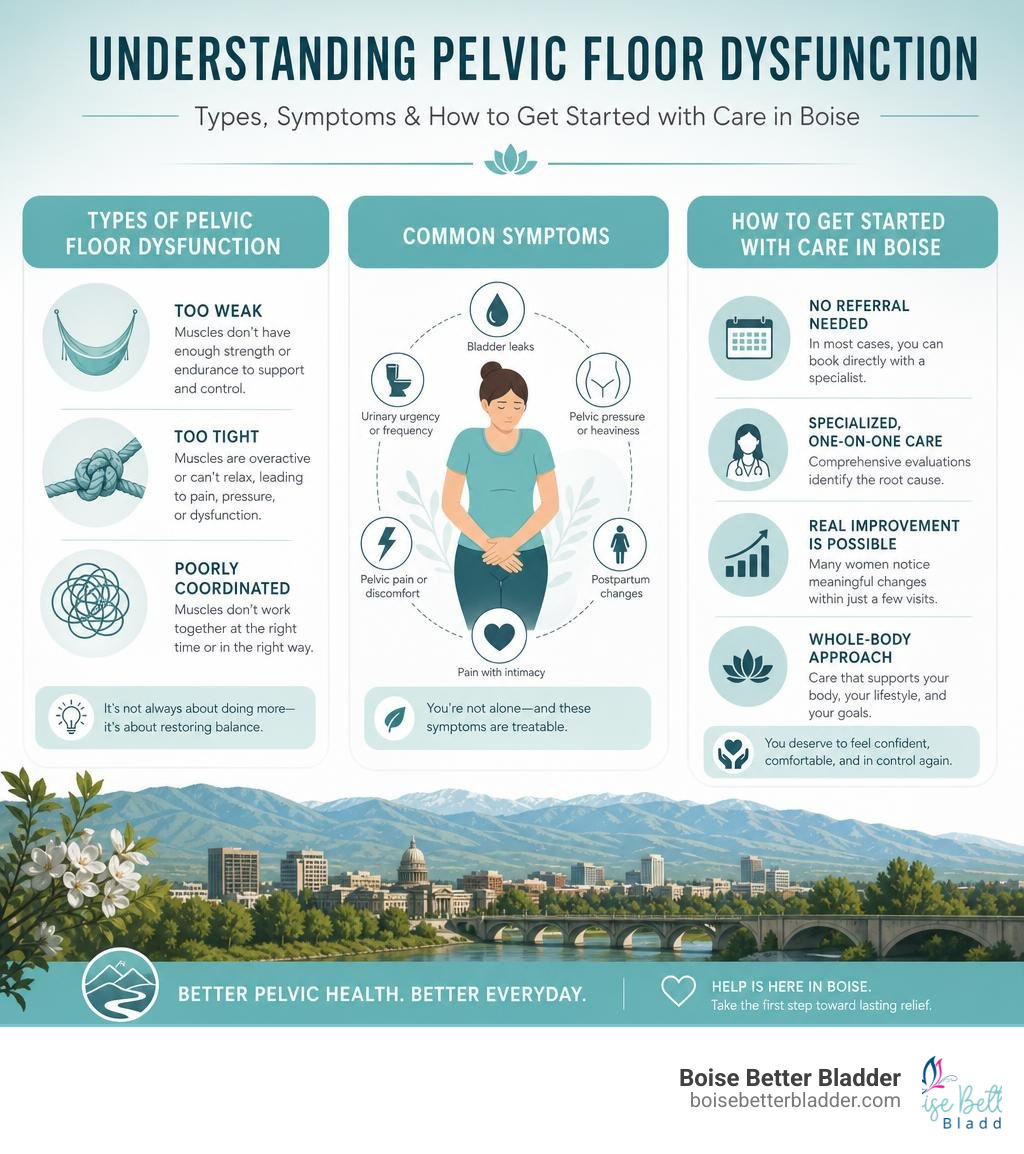
If you are looking for pelvic floor therapy boise, here is a quick overview of what to know before you begin:
What it is: A specialized form of therapy that treats the muscles, nerves, and connective tissue of the pelvic floor
Who it helps: Women at any life stage — including those dealing with bladder leaks, pelvic pain, urgency, or postpartum changes
Where to start: No referral is required in most cases — you can book directly with a specialist
How soon it works: Many patients notice meaningful improvement within their first few sessions
What makes it different: Effective care goes beyond Kegels — it identifies whether your pelvic floor is too weak, too tight, or poorly coordinated
Pelvic floor disorders are more common than most people realize. They affect 35% of all women — and that number climbs to 50% in women over 65. Yet many women spend years quietly managing symptoms on their own, assuming leaks, pressure, or urgency are simply part of getting older.
They are not.
Your body is not failing you. These symptoms are signals — patterns your body is using to communicate that something in the pelvic system is out of balance. Understanding why those signals are happening is where real recovery begins.
What I have seen in clinical practice is that most women who come to me have already tried something — Kegel exercises, a course of physical therapy, or medications — and felt discouraged when the results did not last. That frustration is completely valid. But it usually means the root cause was never fully identified, not that the problem is untreatable.
I'm Dr. Kimberly Thompson, DACM, L.Ac., and I have spent years helping women in Boise navigate exactly this kind of situation — working at the intersection of pelvic floor therapy boise, acupuncture, and advanced muscle rehabilitation technology to address the deeper patterns behind bladder and pelvic symptoms. This guide will walk you through everything you need to know to find the right care for your body.
The Role of Pelvic Restoration in Restoring Balance
When we think about the pelvic floor, it is helpful to picture it not as an isolated group of muscles, but as the literal foundation of your entire core. It is a dynamic hammock of muscles, ligaments, nerves, and connective tissue that supports your bladder, uterus, and bowel. It plays a critical role in core stability, posture, sexual health, and lymphatic circulation.
When this foundation is out of alignment, the entire structure above it must compensate.
The body works in patterns. If a muscle group in your lower back or hip is tight, your pelvic floor may tighten in response to maintain stability. Over time, this constant tension exhausts the muscles, leading to coordination loss, bladder leaks, or chronic pelvic discomfort.
To understand how we can restore this balance, we must look at the body's natural pathways of healing and communication. You can learn more about the physiological mechanisms behind this in our detailed guide on How It Works.
What Happens During a Holistic Pelvic Evaluation?
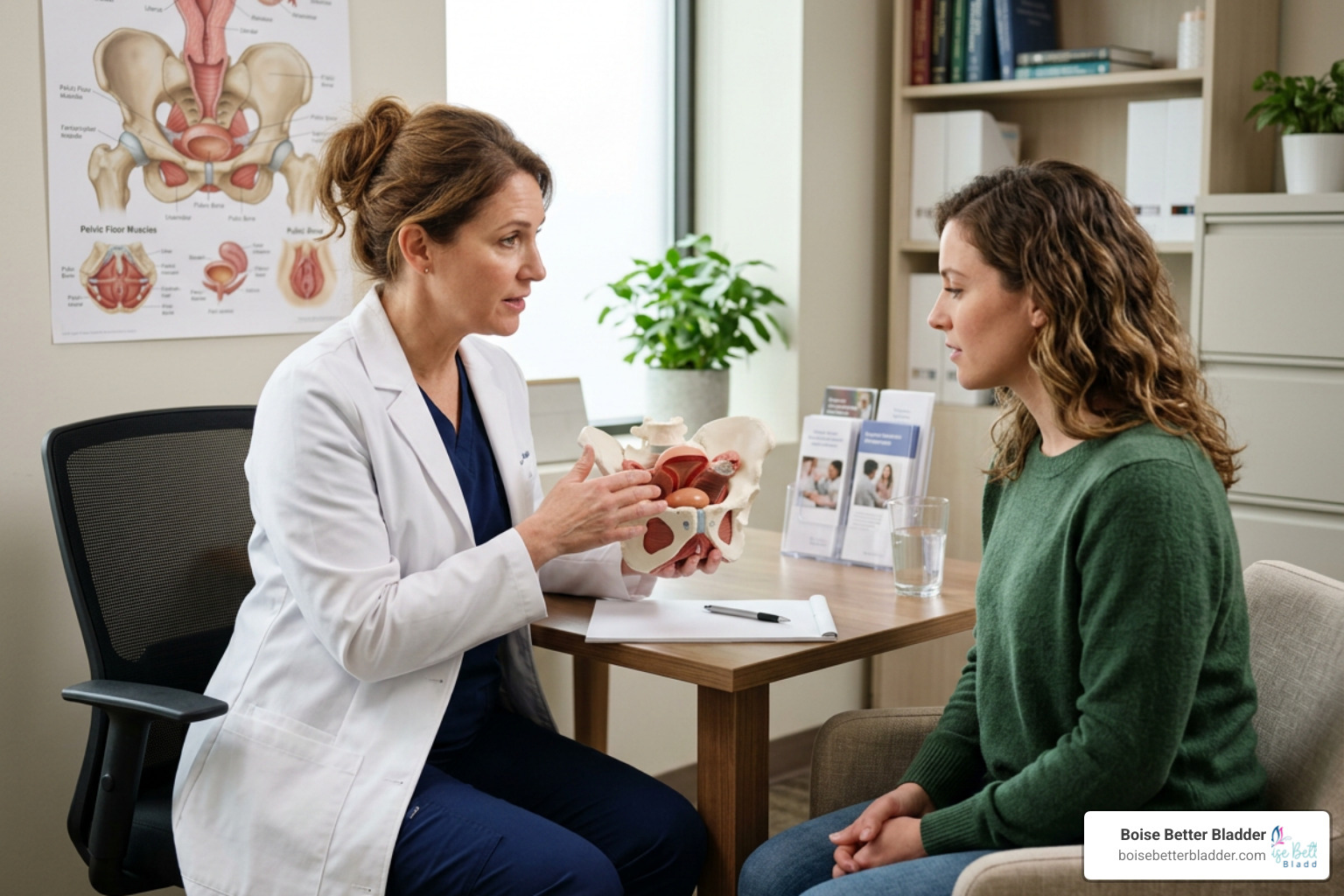
Many women feel apprehensive about seeking help because they do not know what to expect during an evaluation. In a thoughtful, clinical setting, an evaluation is not a rushed or clinical checklist. It is a comprehensive investigation into how your entire body moves, breathes, and holds tension.
A holistic pelvic evaluation typically includes:
A Detailed Medical History: We sit down and look at the big picture. We discuss your obstetric history, surgical history, digestive patterns, stress levels, and daily habits.
Posture and Movement Assessment: We look at how you stand, walk, and breathe. Poor diaphragm movement directly impacts pelvic floor pressure.
Abdominal Assessment: We check for muscle separation (diastasis recti), surgical scar tissue (such as from a C-section or laparoscopic surgery), and areas of bound tension.
External and Internal Muscle Assessment: With your complete comfort and explicit consent, we evaluate the pelvic floor muscles to determine if they are weak, tight, or lacking coordination.
Every step is guided by your comfort. If you prefer to opt out of any part of the assessment, we respect that completely. Our goal is to understand the whole-body patterns contributing to your symptoms, not just to treat a localized muscle.
Who Can Benefit from Non-Invasive Pelvic Restoration?
The short answer is: any woman who feels her daily life is being restricted by pelvic symptoms. Whether you are navigating the physical changes of pregnancy, recovering postpartum, or experiencing hormonal shifts during perimenopause and menopause, your pelvic floor deserves attention.
Pregnant Women: As the baby grows, hormonal changes relax the ligaments, and the physical weight strains the pelvic floor. Proactive care can alleviate pelvic girdle pain and prepare your body for birth.
Postpartum Mothers: Whether you gave birth six weeks ago or sixteen years ago, postpartum recovery is a lifelong journey. Issues like C-section scar tissue, pelvic organ prolapse, and bladder leaks during exercise are highly treatable.
Active Women and Athletes: High-impact sports can put immense pressure on the pelvic floor, leading to "athletic leaks" that should not be accepted as normal.
Women Navigating Menopause: Hormonal changes can cause the tissues of the pelvic region to thin and lose elasticity, leading to sudden urgency or discomfort.
Symptoms are signals. They are telling us that the communication between your nervous system and your pelvic muscles needs to be restored.
Why Traditional Kegels and Quick Fixes Often Fall Short
If you have ever mentioned bladder leaks to a friend or doctor, you were likely told to "just do your Kegels." This is one of the most common misunderstandings in women's health.
The typical explanation is incomplete. It assumes that all pelvic floor dysfunction is caused by weakness. In reality, telling every woman with leaks to do Kegels is like telling someone with a shoulder spasm to lift heavy weights. If the muscle is already chronically tight, squeezing it repeatedly will only worsen the imbalance.
The body works in patterns. To find lasting relief, we must distinguish between different types of pelvic floor patterns.
The Tight vs. Weak Pelvic Floor Pattern
To help you understand what your body might be experiencing, let us look at the two primary patterns of pelvic floor imbalance:
Symptom Category Hypertonic (Tight/Overactive) Pelvic Floor Hypotonic (Weak/Underactive) Pelvic Floor Bladder Symptoms Urinary urgency, frequency, difficulty starting flow, feeling of incomplete emptying Stress incontinence (leaking with coughing, sneezing, jumping, or laughing) Physical Discomfort Pelvic pain, tailbone pain, deep hip pain, pain with intercourse Heaviness or pressure in the pelvis (feeling like something is "falling out") Bowel Patterns Constipation, straining, painful bowel movements Difficulty controlling gas or bowel movements Nervous System High stress, chronic "fight or flight" wind-up, shallow breathing Postural instability, core weakness, hip weakness
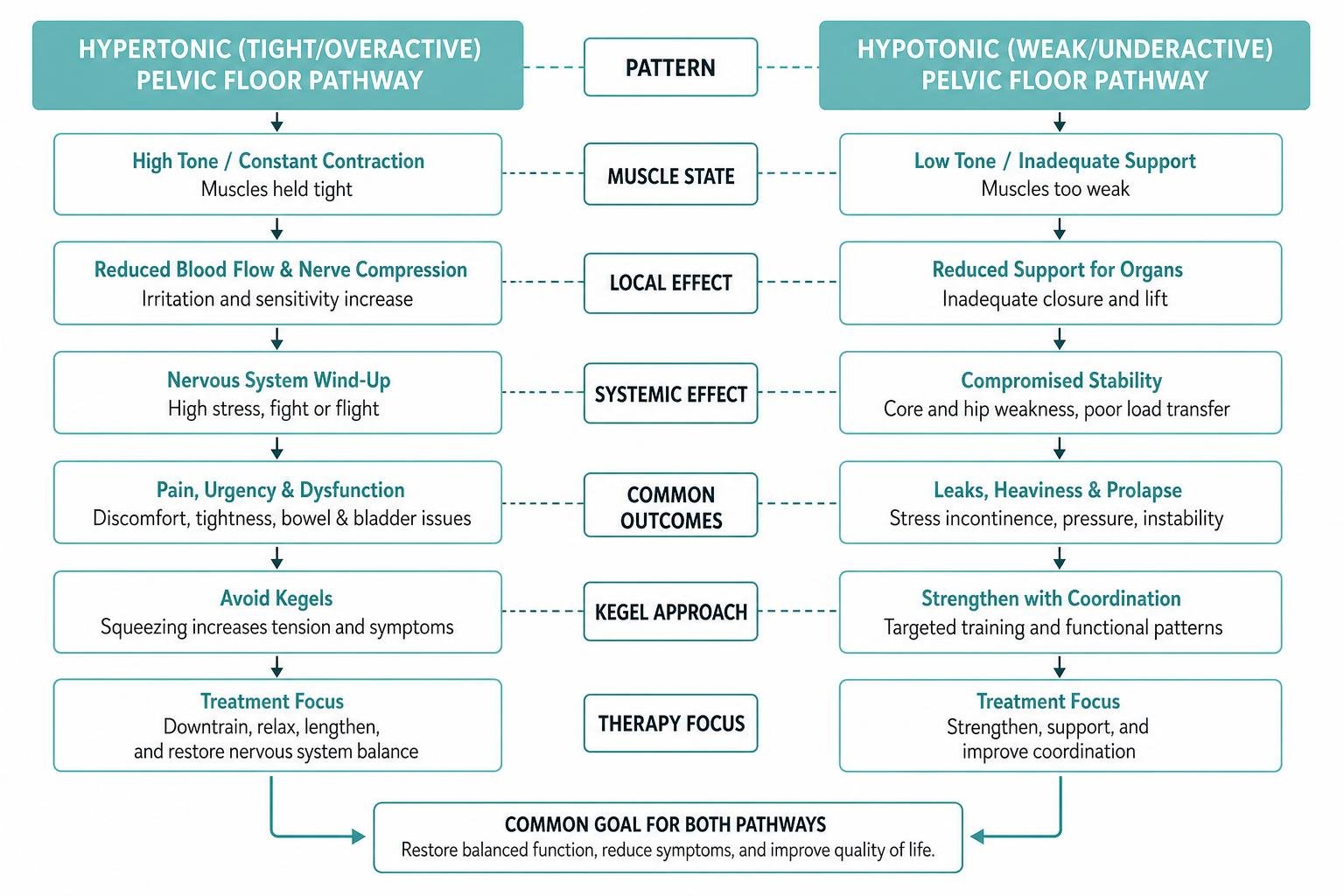
When pelvic floor muscles are hypertonic, they are held in a state of constant contraction. This reduces local blood circulation and compresses the nerves, leading to "nervous system wind-up" and pelvic discomfort. Doing Kegels on an overactive pelvic floor only increases this tension.
Conversely, a hypotonic pelvic floor lacks the resting tone needed to support the pelvic organs, leading to stress leaks and prolapse. True healing requires identifying which pattern your body is holding and restoring the correct muscle coordination.
A Holistic, Non-Invasive Approach to Pelvic Health
At our clinic, we believe that you deserve an alternative to invasive procedures, daily medications, or months of uncomfortable manual therapy. True pelvic restoration requires a whole-body approach that honors how your nervous system, circulation, and muscles interact.
We look at the body as an interconnected web. By combining clinical expertise with time-tested holistic therapies, we help Boise women find lasting freedom. You can read more about our philosophy and meet our dedicated clinical team on our About Us page.
%20(1)%20(1)_compressed.webp?alt=media&token=e2f2a58b-1d4d-4338-93ca-a20d9320e3dc "Peaceful acupuncture session focusing on pelvic wellness and circulation")
How Modern Technology and Acupuncture Restore Communication
We bridge the gap between advanced medical science and holistic healing by combining two powerful modalities: FDA-cleared High-Intensity Focused Electromagnetic (HIFEM) technology and targeted acupuncture.
HIFEM Technology: This non-invasive technology utilizes electromagnetic energy to stimulate deep pelvic floor muscle contractions. A single 30-minute session delivers the equivalent of 25,000 Kegel exercises. This process triggers deep muscle remodeling and neuromuscular re-education, helping your brain and pelvic floor relearn how to communicate effectively.
Holistic Acupuncture: While the technology strengthens and coordinates the muscles, acupuncture addresses the root cause of the imbalance. It calms the nervous system, improves local blood circulation, reduces inflammation, and regulates the energy pathways (Qi) that govern bladder control and pelvic health.
This combined approach does not just mask your symptoms; it restores the structural integrity and nerve communication of your pelvic floor. If you would like to experience this technology firsthand, we invite you to explore our Free Demo Offer.
Frequently Asked Questions About Pelvic Floor Therapy Boise
Do I need a referral for pelvic restoration in Boise?
No, you do not need a physician's referral to begin care with us. Idaho is a direct-access state, meaning you can seek specialized pelvic care directly. This allows you to bypass long wait times and start your healing journey immediately. If you are ready to take the first step, you can Book an Appointment directly online.
How soon can I expect to see results?
While every body is unique, many of our patients experience noticeable relief and improved bladder control after just a few sessions. As the muscles strengthen and the nervous system adapts, these results build over a course of several weeks. We focus on creating sustainable, long-term patterns of health rather than temporary fixes.
Is pelvic restoration covered by insurance?
Because we prioritize highly individualized, one-on-one care without the limitations often imposed by insurance companies, we operate as a specialized cash-based clinic. However, we accept Health Savings Accounts (HSA) and Flexible Spending Accounts (FSA). Upon request, we can also provide you with a superbill (an itemized medical receipt) that you can submit to your insurance provider for potential out-of-network reimbursement.
Conclusion
Your pelvic health is too important to put on hold. Leaks, urgency, and pelvic pain may be common, but they are not a normal part of being a woman.
Your body isn’t failing you. It is simply asking for balance.
Through a thoughtful combination of advanced HIFEM technology and holistic acupuncture, we help women across Boise, Meridian, Eagle, Nampa, and Caldwell reclaim their confidence, their freedom, and their lives. You do not have to accept pelvic dysfunction as your permanent reality.
If you are ready to listen to your body's signals and address the root cause of your symptoms, we invite you to take the next step. Schedule your personalized consultation with us today at Boise Better Bladder and let us help you feel strong, free, and fully supported.
