Pelvic Floor Exercises for Women
Why So Many Women Struggle — and What Pelvic Floor Exercises for Women Actually Do
Pelvic floor exercises for women are one of the most recommended — and most misunderstood — tools in women's health.
Here's a quick answer if you need it now:
The core pelvic floor exercises for women:
Long squeezes (endurance) — Tighten and lift the pelvic floor muscles, hold for 3–10 seconds, relax fully, repeat up to 10 times
Short squeezes (power) — Quickly contract and release, repeat 10–20 times
The "knack" — Squeeze just before coughing, sneezing, or lifting to prevent leaks
Relaxation breathing — Inhale deeply, let the belly expand, exhale and consciously release the pelvic floor (essential for tight muscles)
Aim for: 3 sets daily | Results begin at 6–8 weeks | Significant improvement by 3–6 months
Here's what I see consistently in my clinic: women who have quietly been managing leaks, urgency, or heaviness for years — often told it's "just part of aging." Many have tried Kegel exercises before, sometimes for months, without meaningful results.
That frustration is real. And it makes sense. Up to a third of women who attempt pelvic floor exercises do them incorrectly. Some are actually tightening muscles that are already too tense. Others are doing the right movement — but in isolation, without addressing the deeper patterns of nerve communication and muscle coordination that drive lasting recovery.
Your symptoms are not a character flaw. They're signals. Your body is communicating that something in the support system underneath your pelvis needs attention.
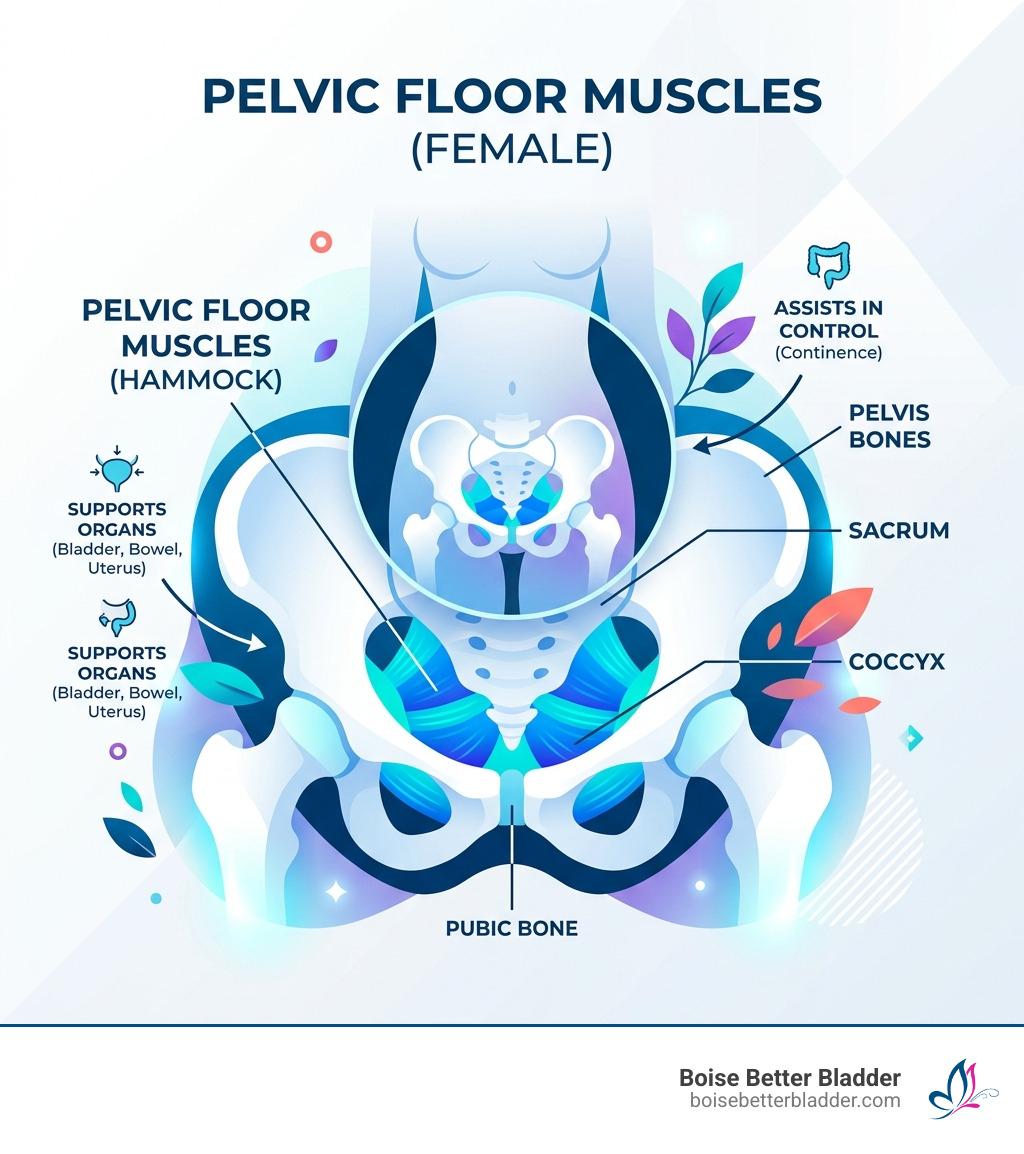
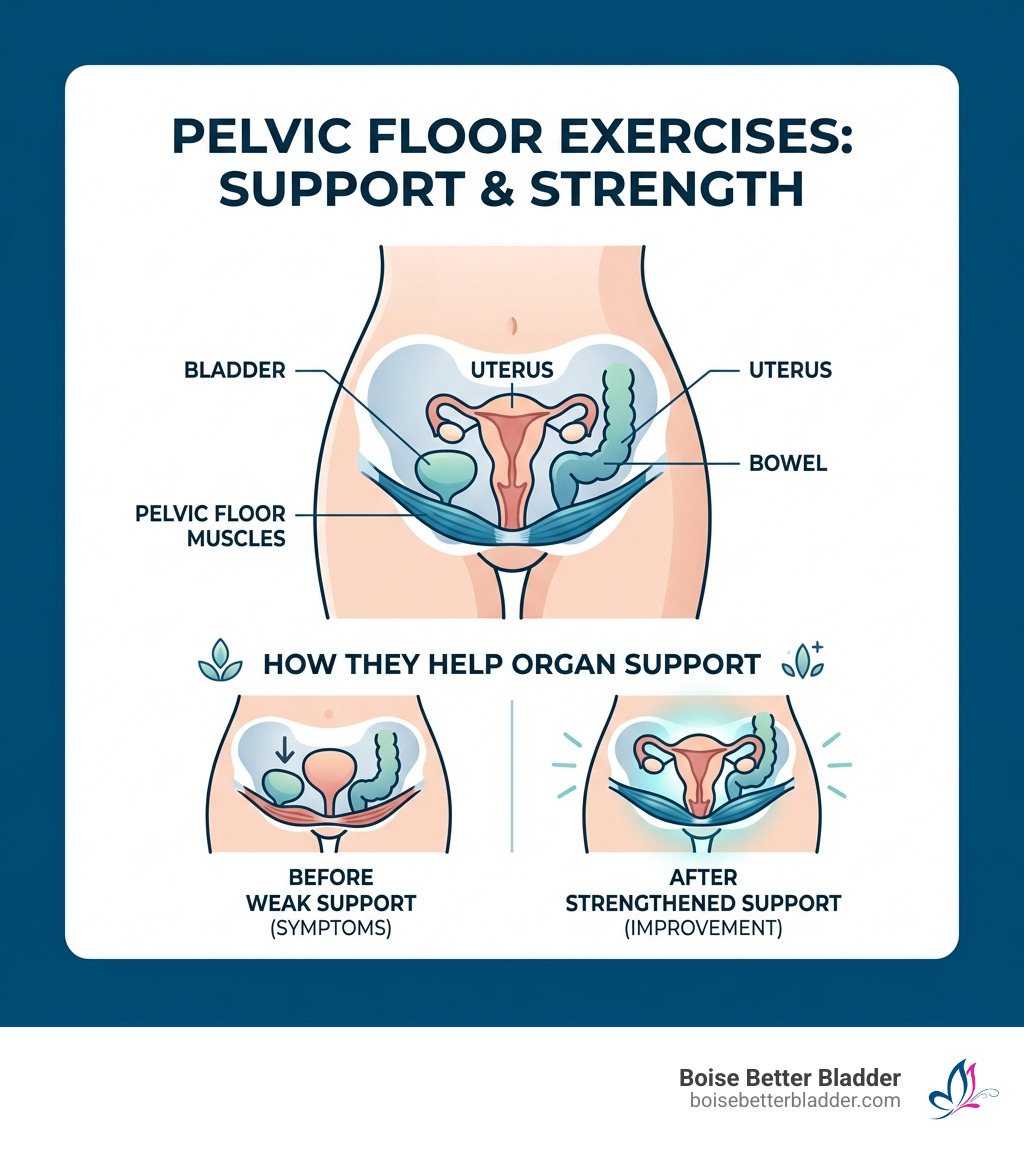
The pelvic floor is a group of muscles, ligaments, and connective tissue that spans the base of your pelvis. These muscles hold your bladder, uterus, and bowel in place. They control when you release urine, gas, and stool. They respond to pressure — every cough, sneeze, and laugh sends a wave of force downward, and a healthy pelvic floor responds by contracting to hold the line.
When that system weakens — through childbirth, hormonal shifts, aging, or simply years of underuse — the signals start to break down. Leaks happen. Urgency increases. The body isn't failing you. It's asking for support.
I'm Dr. Kimberly Thompson, DACM, L.Ac., and I've spent years helping women in Boise and beyond understand and address the root causes of pelvic floor dysfunction through an integrative approach that goes beyond standard pelvic floor exercises for women. In this guide, I'll walk you through everything you need — the correct technique, the common mistakes, and the full picture of what real recovery looks like.
The Anatomy of Support: Why Pelvic Floor Exercises for Women are Essential
To understand why these exercises matter, we first have to look at the "hammock." Imagine a group of muscles and ligaments stretching from your pubic bone at the front to your tailbone (sacrum) at the back. This is your pelvic floor. It isn’t just a floor; it’s a dynamic support system.
When this system is functioning correctly, it performs several vital roles:
Bladder and Bowel Control: These muscles wrap around the passages (urethra and anus). When they contract, they "hold on" until you reach a toilet.
Organ Support: They act as a shelf for the bladder, uterus, and bowel. Without this support, these organs can descend—a condition known as pelvic organ prolapse.
Sexual Function: Stronger muscles can lead to increased blood flow and improved sensation during intercourse.
Core Stability: The pelvic floor works in tandem with your deep abdominal muscles and diaphragm. It is the literal base of your core.
As noted by Harvard Health, these exercises are a first-line defense against stress incontinence (leaking when you laugh or sneeze) and urge incontinence (that sudden, overwhelming need to go). Whether you are a woman or a man, pelvic floor exercises are essential for maintaining this internal structural integrity.
Patterns of Weakness and Dysfunction
In my clinical experience, I’ve found that weakness rarely happens in a vacuum. It usually follows a specific pattern or life event. The body works in patterns. When we recognize these patterns, we can address the root cause rather than just chasing the symptoms.
The Pregnancy Pattern: Carrying a baby for nine months places significant, constant pressure on the pelvic floor.
The Childbirth Pattern: Vaginal delivery, especially with prolonged pushing or a large baby, can stretch or damage the nerves and muscle fibers.
The Menopause Transition: As estrogen levels drop, the tissues in the pelvic region can become thinner and less elastic, leading to a loss of tone.
The Straining Pattern: Chronic constipation, a persistent heavy cough, or repetitive heavy lifting creates a downward pressure that eventually weakens the "hammock."
Your body isn't failing you; it is reacting to the demands placed upon it.
Mastering the Technique: A Step-by-Step Guide
The most startling statistic in pelvic health is that roughly 25% to 50% of women cannot correctly activate their pelvic floor muscles when simply given written instructions. Many women accidentally push down (like they are having a bowel movement) instead of lifting up.
Identifying Pelvic Floor Exercises for Women: Finding Your Center
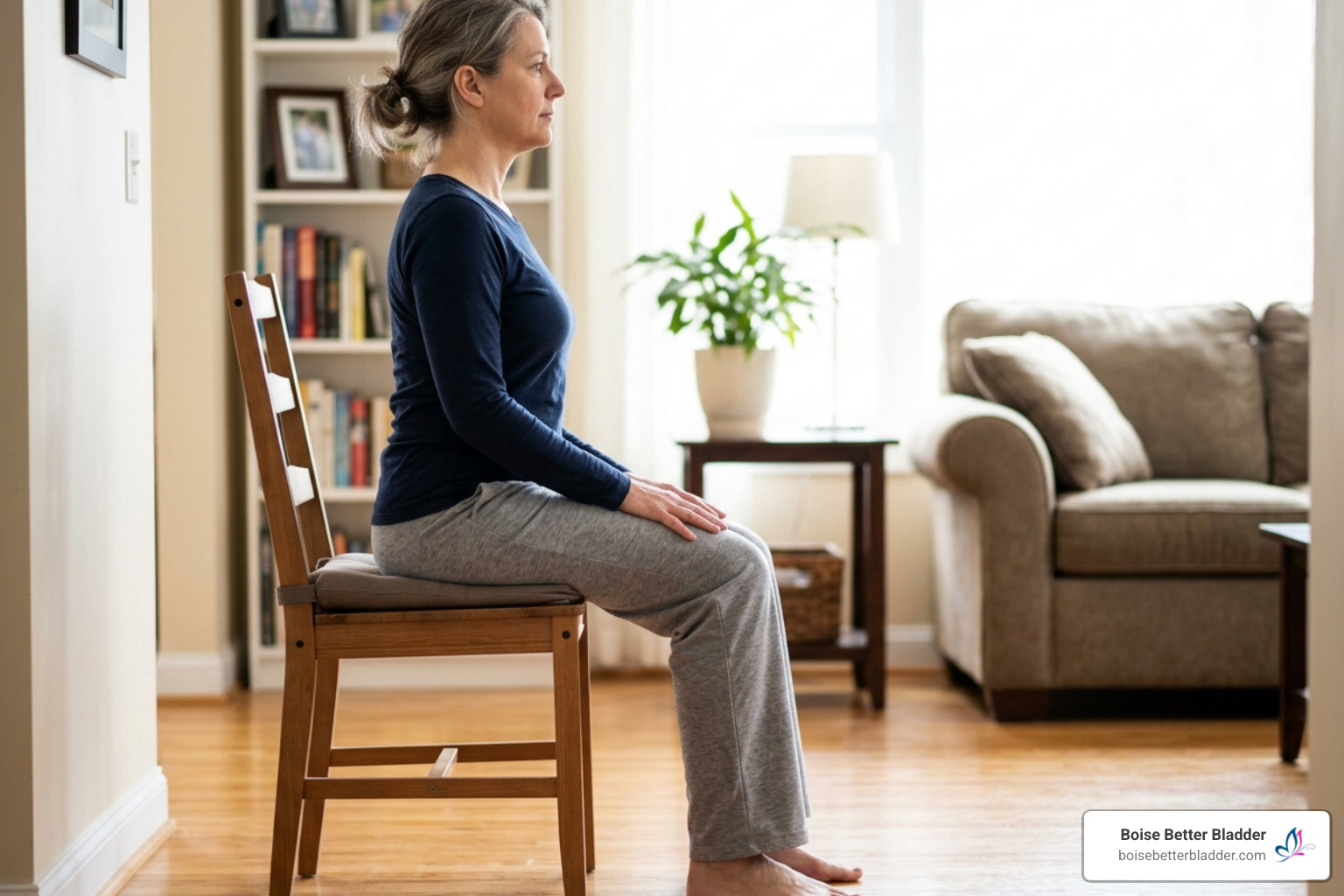
Before you can strengthen a muscle, you have to find it. Here are the most effective ways to locate your pelvic floor:
The Wind Test: Imagine you are in a quiet elevator and feel the urge to pass gas. Squeeze the muscles around your anus to "hold it in." That lift and squeeze is your posterior pelvic floor.
The Tampon Squeeze: Imagine you have a tampon in your vagina and you are trying to "grip" it and lift it up toward your belly button.
The Mirror Check: This is highly recommended for visual learners. Lie on your back with your knees bent and a mirror between your legs. When you contract correctly, you should see the anus and the entrance to the vagina lift and draw inward. If you see the openings widen, you are pushing down.
The Finger Test: Insert a clean finger into the vagina and squeeze. You should feel a distinct tightening around your finger.
Important Note: While you can try to stop the flow of urine midstream once to identify the muscles, do not make this a habit. Habitually stopping your pee can lead to incomplete bladder emptying and urinary tract infections.
Long Squeezes vs. Short Squeezes
A functional pelvic floor needs two things: endurance and power. We train these using two different types of contractions.
Long Squeezes (Endurance): These target the "slow-twitch" fibers that keep your organs supported all day. Tighten your muscles as strongly as you can, hold for 3 to 10 seconds, and then relax for the same amount of time.
Short Squeezes (Power): These target the "fast-twitch" fibers needed for sudden pressure. Squeeze quickly and strongly for one second, then let go immediately. These are your "quick flicks."
According to Harvard Health, practicing both types ensures your muscles can handle both the long walk and the sudden sneeze.
Creating a Sustainable Routine for Pelvic Floor Exercises for Women
Consistency is the bridge between where you are and where you want to be. I often suggest "habit stacking"—attaching your exercises to something you already do every day.
The Routine: Aim for 10 long squeezes and 10 short squeezes, performed three times a day.
The Progression: Start lying down where gravity is neutralized. Once you can hold a 10-second squeeze comfortably, move to sitting, and eventually to standing or even walking.
The Reminders: Use a post-it note on the bathroom mirror, or do a set every time you are stopped at a red light.
If you find that manual exercises aren't producing the results you need, you can learn more about how it works when we integrate advanced technology to accelerate the process.
Beyond the Basics: Advanced Movement and Modern Recovery
While Kegels are the foundation, the pelvic floor doesn't work alone. It is part of a functional chain that includes the glutes, hips, and core.
To truly master pelvic floor exercises for women, we should integrate them into compound movements:
The Bridge Pose: Lie on your back with knees bent. As you lift your hips off the floor, exhale and engage your pelvic floor. Hold for 10 seconds, then slowly lower.
Squat Integration: As you lower into a squat, keep the floor relaxed. As you stand back up, squeeze and lift the pelvic floor to help power the movement.
Pelvic Tilts: Lie on your back and gently flatten your lower back against the floor by tilting your pelvis. This helps coordinate the deep abdominals with the pelvic floor.
Bird Dog: On hands and knees, extend the opposite arm and leg while maintaining a "lifted" pelvic floor. This builds stability and nerve-muscle coordination.
The Role of Modern Technology in Pelvic Health
At Boise Better Bladder, we recognize that for some women, the "brain-to-muscle" connection is severely disrupted. If the nerves aren't communicating effectively, even the best exercises can feel like shouting into a void.
This is where we take a different approach. We combine the ancient wisdom of acupuncture—which improves circulation and nerve communication—with FDA-cleared HIFEM (High-Intensity Focused Electromagnetic) technology.
Imagine doing 25,000 Kegels in 30 minutes while sitting fully clothed in a chair. That is what our technology provides. It forces the muscles to contract at a frequency and intensity that is impossible to achieve manually. This "re-boots" the system, allowing women who have struggled for years to finally see results and testimonials that traditional therapy couldn't provide.
Symptoms are signals. We don't just want to mask the leak; we want to restore the support.
Troubleshooting: Common Mistakes and the Need for Relaxation
More is not always better. One of the most common issues I see is the "over-active" or hypertonic pelvic floor.
If your muscles are always partially contracted, they become fatigued and brittle. They can't respond to a sudden sneeze because they are already "maxed out." In these cases, doing more Kegels can actually make your symptoms worse, leading to pelvic pain or increased urgency.
Common Mistakes to Avoid:
Breath Holding: If you hold your breath, you create internal pressure that pushes down on the pelvic floor. Always breathe out as you squeeze.
Glute Clenching: Your butt muscles are not your pelvic floor. If your cheeks are squeezing together, you aren't isolating the right area.
Bearing Down: This is the most dangerous mistake. Ensure you are lifting "up and in" like a claw machine, not pushing out.
As Mayo Clinic advises, if you feel pain in your back or abdomen after doing your exercises, it’s a sign you are using too much "accessory" muscle and not enough pelvic floor.
The Importance of the Relaxation Phase
The relaxation is just as important as the contraction. Think of it like a bicep curl; if you never straighten your arm, the muscle eventually cramps and loses power.
For those with a tight pelvic floor, we practice "Reverse Kegels" or diaphragmatic breathing:
Inhale deeply into your belly.
Visualize your pelvic floor dropping and opening like a blooming flower.
Exhale and simply let the tension go.
This regulates the nervous system and ensures the muscles remain elastic and responsive. For more on this, see the complete guide to bladder control.
Frequently Asked Questions
How long does it take to see results from pelvic floor training?
The body works in patterns, and change takes time. But with our program, you can not only get results that most women cannot achieve doing these exercises manually, but in a significantly shorter timespan. Most women notice significant strength building and a difference in their coordination and "brain-muscle" connection within 2 to 3 weeks. Our full program is 4 weeks long, and we offer maintenance tune-ups for lasting results.
Can I do these exercises during pregnancy or postpartum?
Yes, and you should! During pregnancy, they help support the extra weight of the baby. Postpartum, they are essential for healing the tissues. However, if you had a complicated delivery or a C-section, always wait for your 6-week clearance from your doctor before starting an intensive program.
When should I see a pelvic floor physical therapist?
If you have been doing your exercises for 3 months without any improvement, or if you feel a "bulge" or "heaviness" in the vagina, it is time for a professional evaluation. Persistent pain during intercourse or an inability to empty your bladder are also signals that you need specialized help.
Conclusion
Your body isn’t failing you. The leaks, the urgency, and the loss of confidence are simply signals that your internal support system needs a more focused approach.
Whether you are mastering pelvic floor exercises for women at home or seeking the accelerated recovery we provide at Boise Better Bladder, the goal is the same: to restore the natural patterns of your body. By combining the right technique, consistent habits, and modern technology when necessary, you can regain the freedom to live your life without worrying about the nearest restroom.
The body works in patterns. Let's start a new pattern of strength and confidence today.
If you are ready to address the root cause of your symptoms and want to see if our non-invasive approach is right for you, we invite you to book an appointment for a pelvic health evaluation. You can also contact us with any questions about our Meridian and Boise locations.
