
Stop the Leak with These Simple Nampa Urinary Exercises
Bladder Leaks Don't Have to Be Your New Normal
If you're looking for Nampa bladder exercises to stop leaks and regain control, here's a quick overview of the most effective options:
Kegel exercises - Contract and hold your pelvic floor muscles for 5–10 seconds, then fully relax. Repeat 8–10 times, three times daily.
Quick flicks - Rapid, short contractions (1–2 seconds) to stop sudden urges in their tracks.
The Knack - A timed pelvic squeeze just before coughing, sneezing, or laughing to prevent stress leaks.
Bridge exercises - Lie on your back, contract your pelvic floor, lift your hips, hold for 5–10 seconds, then lower slowly.
Bladder retraining - Urinate on a set schedule and gradually extend the time between visits to rebuild bladder capacity.
You've probably been told bladder leaks are just part of getting older. Or that you simply need to do more Kegels.
But if you've already tried exercises — and you're still wearing a pad, still mapping out the nearest restroom, still hesitating before a long car ride — something else is going on.
Your body isn't failing you. It's sending signals.
Bladder leaks are not a character flaw or an inevitable consequence of age. They are a pattern — one rooted in a breakdown of communication between your muscles, your nervous system, and your bladder. And patterns can be understood. Patterns can be changed.
Approximately 75% of women with bladder leakage never discuss it with their doctor. That silence comes at a real cost: missed trips, missed moments, a quiet shrinking of life.
You deserve better than that.
I'm Dr. Kimberly Thompson, DACM, L.Ac., and I've spent years helping women in the Nampa and Boise area address the root causes of bladder control issues — including guiding them through the right Nampa bladder exercises alongside integrative approaches that traditional care often overlooks. In this guide, I'll walk you through exactly what works, why it works, and when you may need more than exercises alone.
Understanding the Root Cause of Bladder Leaks
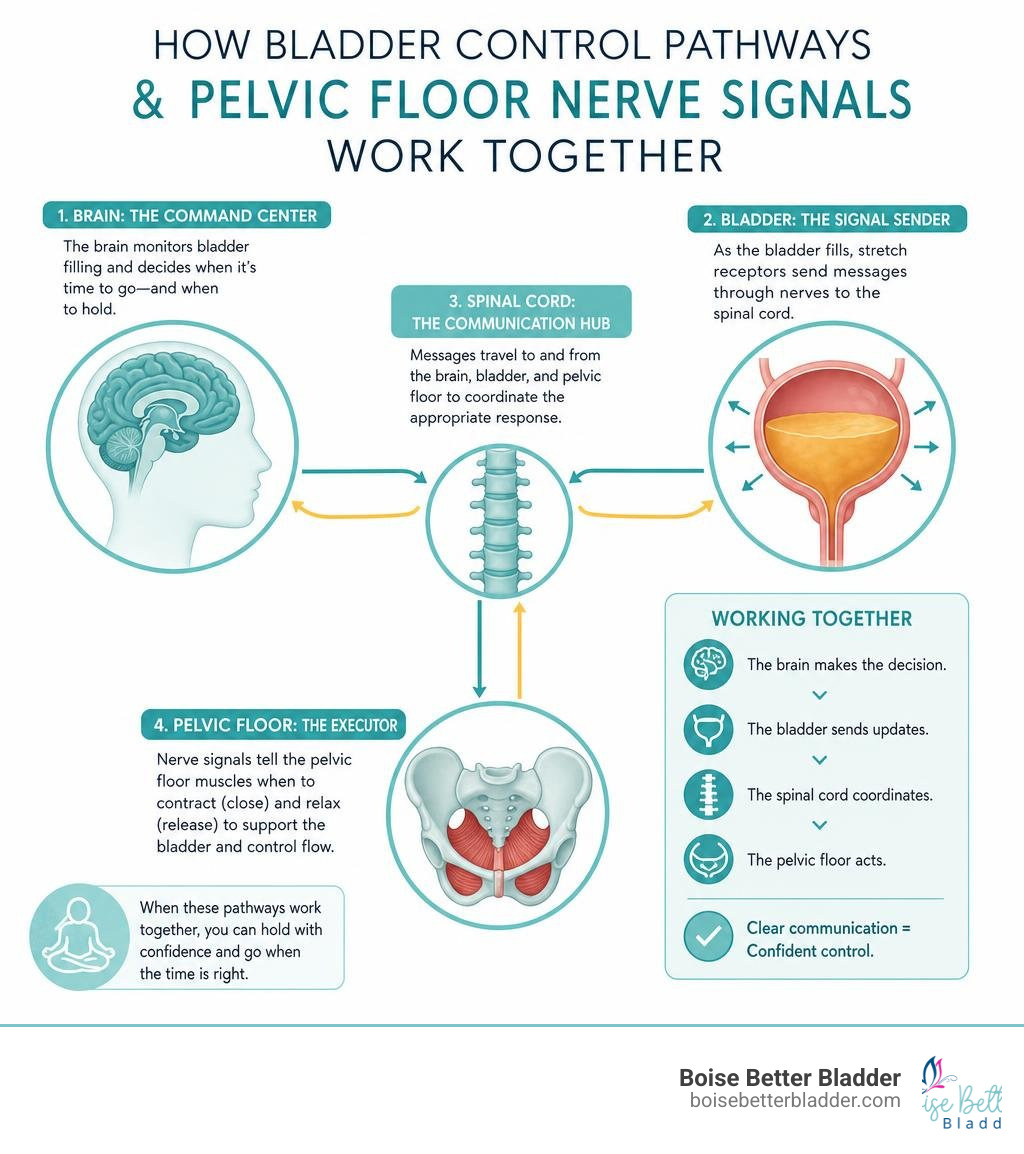
To understand why your bladder is leaking, we must first look at how the entire system communicates.
The body works in patterns.
Your pelvic floor is not an isolated group of muscles operating in a vacuum. It is the literal foundation of your core, working in perfect harmony with your diaphragm, your deep abdominal muscles, and your lower back. When you breathe, your diaphragm moves down, and your pelvic floor gently stretches to accommodate that pressure. When you exhale, both lift.
When this coordinated pattern is disrupted — whether by postural changes, pregnancy, chronic straining, or stress — the system begins to experience imbalances. We categorize these imbalances into three primary leakage patterns:
Stress Urinary Incontinence (SUI): This pattern occurs when physical pressure is placed on the bladder. When you laugh, sneeze, cough, or jump, intra-abdominal pressure spikes. If the structural support tissues and urethral sphincters are weakened, they cannot withstand this sudden pressure, and a leak occurs. SUI is often a result of physical changes, such as those experienced during childbirth or menopause.
Urge Urinary Incontinence (UUI): This pattern is characterized by a sudden, intense, and uncontrollable need to urinate, often followed by involuntary leakage. This is not necessarily a structural weakness of the muscles, but rather a neurological communication issue. The detrusor muscle — the muscular wall of your bladder — contracts prematurely, sending urgent, false signals to your brain that the bladder is full when it may only contain a small amount of urine.
Mixed Urinary Incontinence (MUI): Many women in Nampa experience a combination of both patterns. They might leak when they sneeze (stress) and also experience sudden, overwhelming urges when they hear running water or put their keys in the front door (urge).
Understanding which pattern your body is expressing is essential before starting any exercise program. For instance, performing traditional Pelvic Floor Exercises for Women can be incredibly beneficial for stress-induced leaks, but if your urge incontinence is driven by an overactive nervous system or hypertonic (overly tight) muscles, simply tightening the pelvic floor over and over may actually make your symptoms worse.
Furthermore, structural changes like pelvic organ prolapse — where the bladder, uterus, or bowel bulges slightly into the vaginal wall due to weakened connective tissues — can physically alter the angle of your urethra, making it much harder for your muscles to close the bladder opening effectively.
How Nampa Bladder Exercises Restore Pelvic Harmony
When we approach pelvic health, we aren't just trying to make a muscle "stronger" in the traditional weightlifting sense. We are trying to restore neurological coordination, improve local blood circulation, and rebuild tissue elasticity.
Symptoms are signals.
If you are experiencing leaks, your pelvic floor is signaling that it has lost its rhythm. Targeted nampa bladder exercises help restore that rhythm by rebuilding the brain-body connection. When you perform pelvic muscle training correctly, you are teaching your nervous system to reflexively engage these muscles before a physical stressor occurs, and to calm the bladder's detrusor muscle when a sudden urge strikes.
Clinical research supports this approach. In fact, studies such as the clinical trial on the Effects of Bladder Training and Pelvic Floor Muscle Training on the Symptomatology of Overactive Bladder Syndrome demonstrate that combining physical exercises with behavioral training significantly improves bladder capacity and reduces urgency symptoms. By engaging in consistent, mindful movement, you can experience a 50% to 60% improvement in stress incontinence symptoms.
If you have been struggling with weakness or coordination issues, starting with gentle, restorative Weak Pelvic Floor Exercises is the safest way to reintroduce your brain to these deep muscle pathways.
Step-by-Step Guide to Pelvic Floor Muscle Training
To begin your home program, you must first learn how to isolate the pelvic floor without compensating with your abdomen, buttocks, or inner thighs.
1. Locating the Correct Muscles
The easiest way to find your pelvic floor muscles is to imagine that you are trying to stop the flow of urine mid-stream, or trying to avoid passing gas. You should feel a distinct "squeeze and lift" sensation internally. Note: Do not regularly practice stopping your urine stream while actually on the toilet, as this can disrupt your bladder's natural emptying reflex and lead to urinary tract infections.
2. Engaging Type I Slow-Twitch Fibers (Endurance)
Your pelvic floor is made up of roughly 70% slow-twitch muscle fibers. These fibers are responsible for keeping your bladder supported throughout the day.
The Exercise: Lie on your back with your knees bent and feet flat on the floor. Take a deep, diaphragmatic breath in, allowing your belly and pelvic floor to fully relax. As you exhale, gently squeeze and lift your pelvic floor muscles.
The Hold: Hold this contraction for 5 to 10 seconds. Keep breathing naturally; do not hold your breath.
The Release: Fully relax the muscles for 10 to 20 seconds. The relaxation phase is just as important as the contraction.
Repetitions: Complete 8 to 10 holds, three times per day.
3. Engaging Type II Fast-Twitch Fibers (Quick Flicks)
The remaining 30% of your pelvic floor consists of fast-twitch fibers, which react quickly to sudden spikes in pressure or urgent spasms.
The Exercise: Quickly contract your pelvic floor muscles as firmly as possible, then immediately release them.
The Rhythm: Squeeze for 1 second, release for 1 second.
Repetitions: Perform 10 quick flicks in a row, rest for 10 seconds, and repeat for 3 sets daily. This rapid contraction reflexively sends an inhibitory signal to your detrusor muscle, helping to quiet sudden bladder spasms.
4. Integrating Bridge Exercises
To build functional support, we want to train the pelvic floor to work in tandem with your glutes and hamstrings.
The Exercise: Lie on your back with your knees bent. Engage your pelvic floor first, then squeeze your glutes and lift your hips off the floor until your body forms a straight line from your knees to your shoulders.
The Hold: Hold the bridge position for 5 seconds while maintaining the pelvic floor contraction.
The Return: Slowly lower your hips back to the floor and completely relax your pelvic floor. Repeat 10 times.
By practicing these variations, you ensure you are focusing on comprehensive Pelvic Muscle Strengthening rather than just repetitive, unbalanced squeezing.
The Knack and Functional Integration
Have you ever leaked right as you coughed, sneezed, or lifted a heavy grocery bag? That is because your body's natural bracing reflex was delayed. We can train this reflex using a technique known as "The Knack."
The Knack is a pre-programmed, voluntary contraction of your pelvic floor muscles performed immediately before an activity that increases abdominal pressure.
Step 1: Identify the trigger (a sneeze, a cough, a laugh, or lifting an object).
Step 2: Just before the trigger occurs, perform a firm, sustained pelvic floor contraction (squeeze and lift).
Step 3: Hold that contraction through the cough or sneeze.
Step 4: Fully release the muscle once the physical stress has passed.
Applying this simple coordination technique acts as a structural brace, pinching the urethra closed and protecting your pelvic organs from being pushed downward. Integrating this habit into your daily movements is a key component of functional Pelvic Muscle Therapy.
Bladder Retraining vs. Pelvic Floor Exercises
Many women confuse pelvic floor exercises with bladder retraining, but they are entirely different pathways. While pelvic floor exercises focus on strengthening and coordinating the physical muscles, bladder retraining is a behavioral program designed to reset the communication between your brain and your bladder.
If you struggle with constant urgency, your bladder has likely been "trained" to empty at very low volumes. This often happens because of a habit I call "just in case" peeing — or what clinicians call preemptive voiding. When you go to the bathroom before leaving the house, before getting in the car, or every time you pass a restroom "just in case," you are teaching your bladder to hold less and less urine. Over time, the bladder wall becomes highly sensitive, triggering intense urges even when it is only partially full.
To quiet this overactivity, we use timed voiding and urge suppression techniques. You can learn more about how to structure these behavioral workouts in The bladder workout: Tame incontinence without surgery - Harvard Health.
For women dealing with severe urgency, combining these habits with a dedicated Overactive Bladder Treatment plan is the most effective way to regain peace of mind.
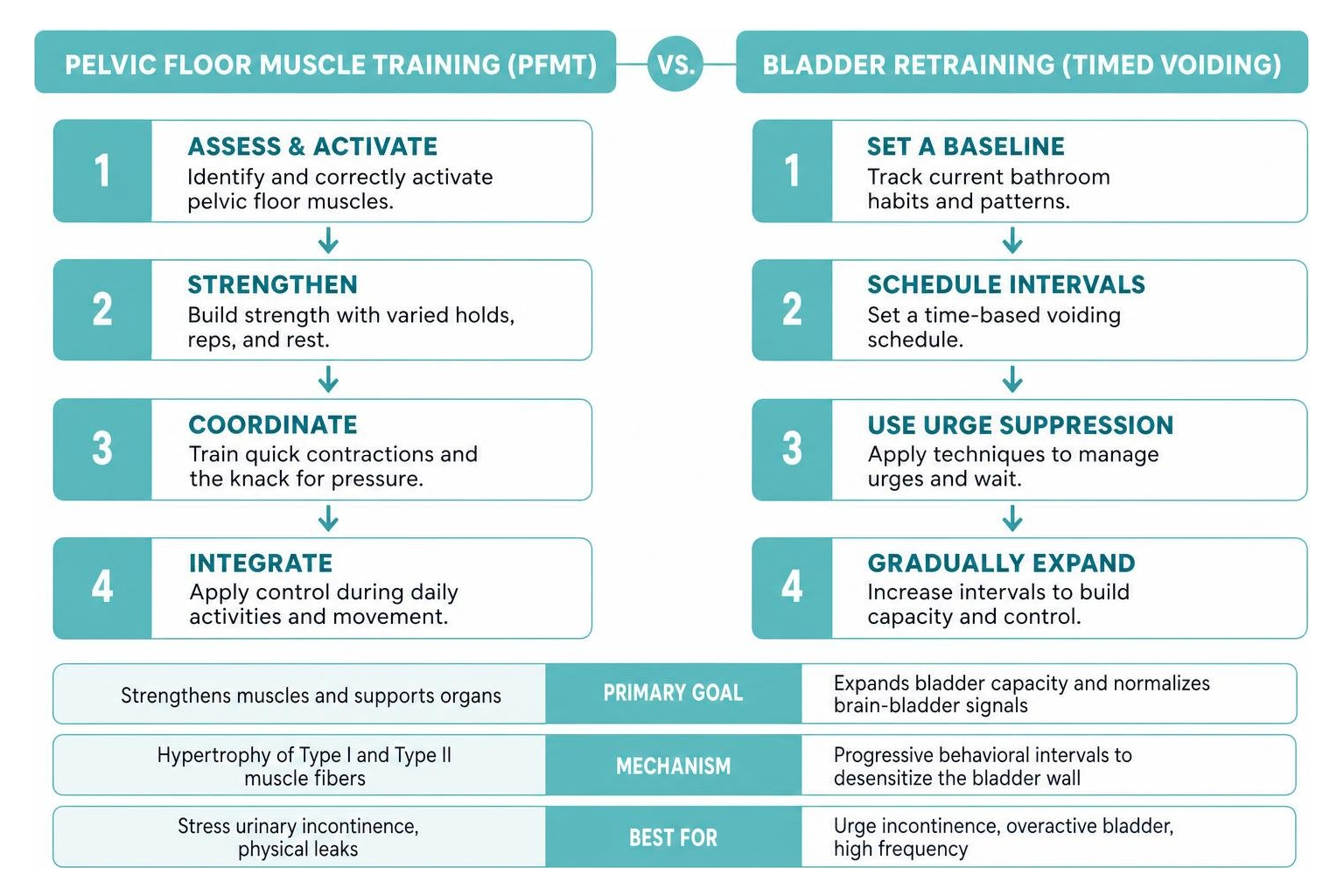
Aspect | Pelvic Floor Muscle Training (PFMT) | Bladder Retraining (Timed Voiding) |
|---|---|---|
Primary Goal | Strengthen physical muscle fibers and support organs | Expand bladder capacity and normalize brain-bladder signals |
Mechanism | Hypertrophy of Type I and Type II muscle fibers | Progressive behavioral intervals to desensitize the bladder wall |
Best For | Stress urinary incontinence, physical leaks | Urge incontinence, overactive bladder, high frequency |
Daily Practice | Sustained Kegels, quick flicks, and bridge exercises | Urinating on a strict schedule, regardless of urge |
Implementing a Structured Retraining Schedule
To begin bladder retraining, you must first complete a bladder diary for two to three days. Note every time you urinate, every time you experience a leak, and what you drank.
Calculate Your Baseline: Find the average time between your bathroom visits. For example, if you typically go every 60 minutes, your baseline is 1 hour.
Set Your Schedule: For the first week, set a timer for your baseline interval (e.g., 60 minutes). You must empty your bladder only when the timer goes off, even if you do not feel the urge. If you feel an urge before the timer, use urge suppression techniques to delay going.
Increase the Interval: Once you can comfortably complete a week without leaking between your scheduled times, increase your interval by 15 to 30 minutes.
The Target: Gradually increase your intervals over 6 weeks until you can comfortably wait 2.5 to 3 hours between visits.
For a comprehensive, week-by-week behavioral roadmap, you can download the NAFC Bladder Retraining Guide.
Holistic Urge Suppression Techniques
When a sudden, intense urge strikes before your scheduled timer, your instinct is likely to run to the bathroom. However, rushing actually increases the mechanical pressure on your bladder and heightens your nervous system's arousal, making the urge even more intense. Instead, stay calm, stand still or sit down, and use these holistic techniques:
Acupressure (Spleen 6 / Sanyinjiao): In acupuncture, we look at the body as an interconnected web of energy and nerve pathways. The Spleen 6 (SP6) point is highly effective for calming bladder spasms. It is located four finger-widths above your inner ankle bone, right behind the back border of the shinbone (tibia). Apply firm, steady pressure to this point for 60 seconds. This stimulates the tibial nerve, which shares pathways with the sacral nerves controlling your bladder, effectively sending a calming signal to the nervous system.
Mental Distraction: Your brain can only focus on a limited number of sensory signals at once. Deliberately shift your focus by counting backward from 100 by 7s, balancing your checkbook in your head, or listing ten historical figures.
Diaphragmatic Deep Breathing: Take slow, deep belly breaths. This shifts your body out of a stressed, sympathetic "fight-or-flight" state and into a calm, parasympathetic state, which naturally relaxes the bladder wall.
Rolled Towel Counter-Pressure: Sit firmly on a rolled-up bath towel placed on a hard chair. The upward physical pressure on your perineum sends an inhibitory reflex signal to your bladder detrusor muscle, telling it to stop contracting.
Clinical Approaches to Pelvic Health in Nampa
While home-based nampa bladder exercises are an excellent starting point, many women find that self-directed routines are not enough to fully resolve their symptoms.
Traditional clinical approaches in Nampa, such as hospital-based outpatient rehabilitation or pelvic physical therapy clinics, often focus heavily on manual internal muscle assessments, biofeedback sensors, and physical exercises. While these traditional therapies can be highly effective for localizing the muscles, they also require a significant time commitment, can feel physically uncomfortable or invasive, and often have high drop-out rates.
Furthermore, isolated muscle training can be incomplete if your provider does not evaluate your overall posture and breathing mechanics. If you hold chronic tension in your jaw, neck, or lower back, that tension is often mirrored in your pelvic floor. Correcting your posture and learning to breathe diaphragmatically are essential to permanently reducing the downward pressure placed on your bladder.
Because of the physical discomfort and slow progress associated with traditional manual therapy, many local women are now exploring modern, non-invasive alternatives. If you are curious about what standard physical therapy evaluations entail, you can read more about Pelvic Floor Physical Therapy Boise.
When to Seek Professional Guidance for Nampa Bladder Exercises
It is a common misconception that everyone with bladder issues should simply do more Kegels. In fact, up to 30% of women perform pelvic floor exercises incorrectly, often pushing downward (bearing down) instead of lifting upward, which can worsen prolapse and stretching.
Additionally, many women suffer from a hypertonic pelvic floor — meaning their muscles are already too tight, short, and unable to fully relax.
The body works in patterns.
When a muscle is chronically tight, it becomes fatigued, weak, and highly sensitive. If you perform repetitive strengthening exercises on an already hypertonic pelvic floor, you will increase your pain, worsen your urinary urgency, and cause further coordination issues.
You should stop home exercises and seek a professional evaluation if you experience any of the following:
Pain, burning, or discomfort in the pelvic region
Pain during or after sexual intercourse (dyspareunia)
Difficulty fully emptying your bladder, or a slow, interrupted urine stream
A constant feeling of heaviness, pressure, or bulging in your pelvis, which often worsens after standing for long periods
If you are experiencing these complex symptoms, it is time to transition to a specialized clinical program. You can learn more about these patterns in our guide on Understanding Weak Pelvic Floor Treatment.
Limitations of Home-Based Nampa Bladder Exercises
It is important to be honest about what home exercises can and cannot achieve. While consistent practice can improve mild to moderate stress leaks, home exercises have clear limitations:
Deep Nerve Dysfunction: If your bladder issues are driven by damaged or miscommunicating nerves (such as from chronic diabetes, back injuries, or hormonal depletion during menopause), simply strengthening the muscle fibers will not fix the underlying signaling issue.
Adherence Challenges: Rebuilding muscle memory requires performing hundreds of precise contractions every single week for months. For busy women, finding the time and maintaining the perfect form required to achieve results is incredibly difficult.
Advanced Structural Issues: Severe pelvic organ prolapse or complete tissue tears cannot be reversed through home exercises alone.
When home care falls short, modern clinical technology can bridge the gap.
Frequently Asked Questions about Bladder Control
How long does it typically take to see results from bladder exercises?
Most women will begin to notice a subtle change in their coordination and control within 6 to 12 weeks of consistent, daily pelvic floor exercises. This initial progress is often due to neural adaptation — your brain becoming better at communicating with the existing muscle fibers. However, to build actual muscle mass and structural support (cellular hypertrophy), you must maintain your routine for at least 4 to 5 months. Once you achieve your goals, you can transition to a maintenance routine of practicing your exercises 3 days per week.
Can dietary changes support bladder exercises?
Yes. What you put into your body directly impacts how your bladder behaves. Highly concentrated urine is acidic and irritates the bladder lining, triggering sudden spasms.
The Hydration Formula: To keep your urine diluted, aim to drink half your body weight in ounces of water daily (for example, if you weigh 160 lbs, aim for 80 ounces of water). Adjust this so your urine is a pale, clear yellow. Avoid restricting your water intake, as dehydration actually makes bladder urgency worse.
Avoid Irritants: Limit foods and drinks high in caffeine, alcohol, carbonated bubbles, artificial sweeteners, and highly acidic citrus fruits.
Is bladder leakage a normal part of aging or childbirth?
No. While bladder leakage is highly common — affecting 35% of all women and up to 50% of women over age 65 — it is never normal. Leaks are a sign of a treatable muscle or nerve imbalance. Hormonal shifts during menopause can thin the urethral tissues, and childbirth can stretch the pelvic ligaments, but these patterns can be restored with the right clinical support at any stage of life.
Reclaiming Your Freedom and Confidence
Your body isn't failing you.
Every leak, every sudden urge, and every moment of hesitation is simply your body communicating that its foundational support system is out of balance. By combining conscious, targeted movement with behavioral retraining, you can begin to rewrite these patterns and restore harmony to your pelvic health.
But you do not have to navigate this path alone.
At Boise Better Bladder, we offer a unique, completely non-invasive approach to pelvic restoration. Our signature program helps women regain complete bladder control without surgery, medications, or uncomfortable manual physical therapy.
We combine advanced, FDA-cleared HIFEM (High-Intensity Focused Electromagnetic) technology — which comfortably delivers the equivalent of 25,000 deep pelvic floor contractions in a single 30-minute session — with restorative, holistic acupuncture. This dual-action approach rebuilds deep muscle strength while simultaneously improving nerve communication and local circulation, addressing the true root cause of your leaks.
If you are ready to stop relying on pads and return to the active life you love, we invite you to learn more about our process:
Explore how our unique technology works on our How It Works page.
Experience the comfort by signing up for our Free Demo Offer Home.
Take the first step toward lasting relief and Book an Appointment for a personal evaluation today.
To learn more about our clinic and our holistic philosophy, visit the Boise Better Bladder Home page. We look forward to supporting you on your journey back to confidence and freedom.
