Weak Pelvic Floor Exercises | Treasure Valley Bladder Control
What Are Weak Pelvic Floor Exercises — and Do You Really Need Them?

Weak pelvic floor exercises are a specific set of movements designed to rebuild strength, coordination, and endurance in the muscles that support your bladder, bowel, and uterus. If you've been quietly dealing with leaks, urgency, or pressure "down there," these exercises are where most recovery begins.
The most effective exercises for a weak pelvic floor include:
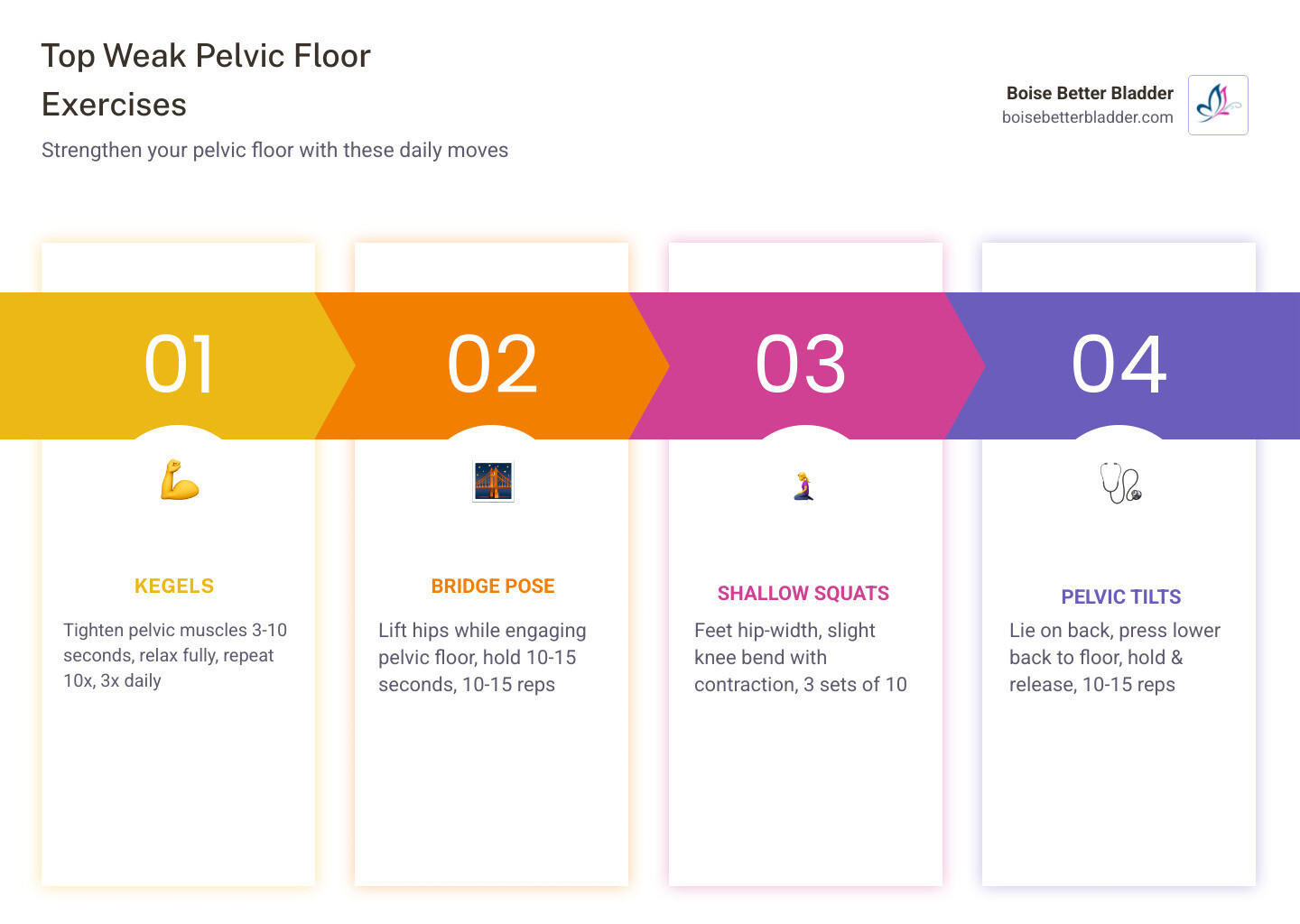
Kegel exercises - Tighten pelvic floor muscles for 3-10 seconds, relax fully, repeat 10 times, 3x daily
Bridge pose - Lift hips while engaging pelvic floor, hold 10-15 seconds, repeat 10-15 times
Shallow squats - Feet hip-width apart, bend knees slightly while contracting pelvic floor, 3 sets of 10
Pelvic tilts - Lie on back, press lower back to floor, hold and release, 10-15 reps
Bird dog - On hands and knees, extend opposite arm and leg while engaging core, alternate sides
Most people notice early improvement within 4-6 weeks of consistent practice. Meaningful, lasting change typically takes 3-6 months.
Here's something I hear from women all the time in my practice: "I've been doing Kegels for years and nothing has changed."
And I believe them. Because doing the exercises is only part of the picture.
The pelvic floor isn't just a muscle you squeeze. It's a layered, dynamic sling of tissue that connects your pubic bone to your sacrum — supporting your bladder, uterus, and bowel, coordinating with your breath, your core, and your nervous system every single moment of the day.
When it weakens — whether from childbirth, hormonal shifts, aging, or chronic straining — your body starts sending signals. Leaks when you laugh. Urgency you can't quite outrun. A subtle heaviness you've learned to ignore.
These aren't signs that your body is failing you. They're signals that one part of a complex system needs attention.
Approximately 32% of women experience at least one form of pelvic floor dysfunction — yet most are either told it's "just part of aging" or handed a generic exercise sheet that doesn't account for how or why their pelvic floor is struggling.
That's exactly the gap this guide is here to fill.
I'm Dr. Kimberly Thompson, DACM, L.Ac., and I've spent years helping women navigate pelvic floor dysfunction through an integrative approach that combines targeted weak pelvic floor exercises, HIFEM technology, and whole-body support. My clinical work has shown me that when women understand why these exercises work — not just how to do them — results follow far more reliably.
Understanding the Pelvic Floor as a Functional Foundation
To understand why weak pelvic floor exercises are necessary, we first have to look at the anatomy of the "basement" of your core. We often describe the pelvic floor as a hammock or a broad sling of muscle fibers and connective tissue. It spans the bottom of your pelvis, stretching from the pubic bone in the front to the sacrum (the base of your spine) in the back.
This muscle group performs four vital roles:
Support: It holds your pelvic organs—the bladder, uterus, and bowel—in their proper place.
Continence: It wraps around the urethra and anus, providing the squeeze needed to prevent leaks.
Stability: It works with your deep abdominal and back muscles to stabilize your spine.
Function: It plays a central role in sexual sensation and the physiological process of orgasm.
When these muscles lose their tone, the "hammock" begins to sag. This can lead to stress incontinence (leaking when you cough or sneeze), urge incontinence (that "gotta go right now" feeling), or even pelvic organ prolapse.
Your body isn't failing you. It is responding to a set of patterns. Perhaps those patterns include the physical strain of childbirth, the hormonal shifts of menopause, or the chronic pressure of a long-term cough or heavy lifting. According to Scientific research on pelvic floor functions, these muscles must be both strong enough to support weight and flexible enough to relax during urination and bowel movements.
The body works in patterns. When the pelvic floor is weak, other muscles—like your hip flexors or lower back—often try to "help," leading to secondary pain in the hips or lumbar spine. Strengthening the floor isn't just about stopping leaks; it’s about restoring the functional foundation of your entire midsection.
Identifying and Isolating the Correct Muscles
One of the biggest hurdles my patients in Boise and Meridian face isn't doing the exercises—it's finding the right muscles to exercise in the first place. If you are squeezing your glutes, tensing your thighs, or holding your breath, you aren't performing weak pelvic floor exercises; you're just doing a very intense leg workout.
To properly isolate the pelvic floor, we recommend these visualization techniques:
The "Stop-Test": Imagine you are mid-stream while urinating and you need to stop the flow. The muscles you feel "lift and squeeze" are your pelvic floor. Note: Only do this once to identify the muscles; doing it repeatedly while actually urinating can confuse your bladder signals.
The "Vending Machine": Imagine your pelvic floor is like one of those claw machines at an arcade. Imagine the claw reaching down, gently gripping a prize (your pelvic organs), and lifting it upward and forward toward your belly button.
Tactile Feedback: For women, inserting a clean finger into the vagina and squeezing can provide immediate feedback. You should feel the muscles tighten around your finger.
The body works in patterns. Many of us have a pattern of "shallow breathing," where we hold tension in our bellies. This makes it almost impossible to engage the pelvic floor correctly. Before you begin any exercise, take a deep breath into your ribs. As you exhale, that is when you should initiate the lift.
If you struggle to feel anything at all, don't worry. This is common. According to this Pelvic muscle identification guide, tools like biofeedback or professional evaluation can help bridge that communication gap between your brain and your basement.
Effective Weak Pelvic Floor Exercises for Daily Strength
Once you've located the muscles, we can begin building a routine. A common mistake is thinking that "more is always better." In reality, your pelvic floor contains two types of muscle fibers: slow-twitch (for all-day endurance) and fast-twitch (for quick reactions when you sneeze). Your weak pelvic floor exercises should target both.
Here is how we break down the movements:
Kegels (The Foundation): These target the muscles directly. We recommend a mix of "long holds" for endurance and "quick flicks" for power.
Bridge Pose: Lie on your back with knees bent. As you lift your hips, focus on that "lift and squeeze" of the pelvic floor. This integrates the floor with your glutes and hamstrings.
Bird Dog: On all fours, extend your right arm and left leg. This requires your pelvic floor to stabilize your core against gravity.
Pelvic Tilts: These are small, subtle movements where you tuck your pelvis to flatten your back against the floor, engaging the lower abdominals and pelvic floor together.
Shallow Squats: Standing with feet hip-width apart, perform a small squat. Engage the pelvic floor as you descend and maintain the lift as you return to standing.
For a deeper look at the mechanics of these movements, you can explore these Five exercises to strengthen your pelvic floor. If you're wondering how these physical movements translate into long-term bladder control, you can find More info about how it works on our dedicated technology page.
Symptoms are signals. If you feel a "bulging" sensation or increased pressure during these exercises, it’s a sign to slow down and check your form.
Mastering the Step-by-Step Kegel Technique
To master the Kegel, follow this specific rhythm:
The Contraction: Squeeze and lift the muscles around the vagina and anus. Hold for 3 seconds.
The Relaxation: This is the most important part. Release the muscles completely for 3 to 5 seconds. If you don't relax, the muscle becomes fatigued and less effective.
The Set: Repeat this 10 times.
The Progression: Once 3 seconds feels easy, work your way up to 10-second holds.
Avoid the "compensation pattern" of clenching your jaw or holding your breath. Your face should remain relaxed while your "basement" does the work.
Integrating Weak Pelvic Floor Exercises into Your Routine
Consistency beats intensity every time. We often suggest "habit stacking" to our patients in Nampa and Eagle.
Red Lights: Do a set of quick flicks every time you hit a red light while driving.
Brushing Teeth: Perform your long endurance holds while brushing your teeth.
"The Knack": This is a functional technique where you perform one strong, intentional pelvic floor contraction right before you cough, sneeze, or lift something heavy. This "pre-hab" protects the muscles from sudden spikes in pressure.
Lifestyle Patterns that Support Pelvic Recovery
Strengthening the muscles is only half the battle; we also must reduce the "load" we put on them. Think of it like this: if you’re trying to strengthen a bridge, you also want to make sure you aren't driving oversized semi-trucks over it all day.
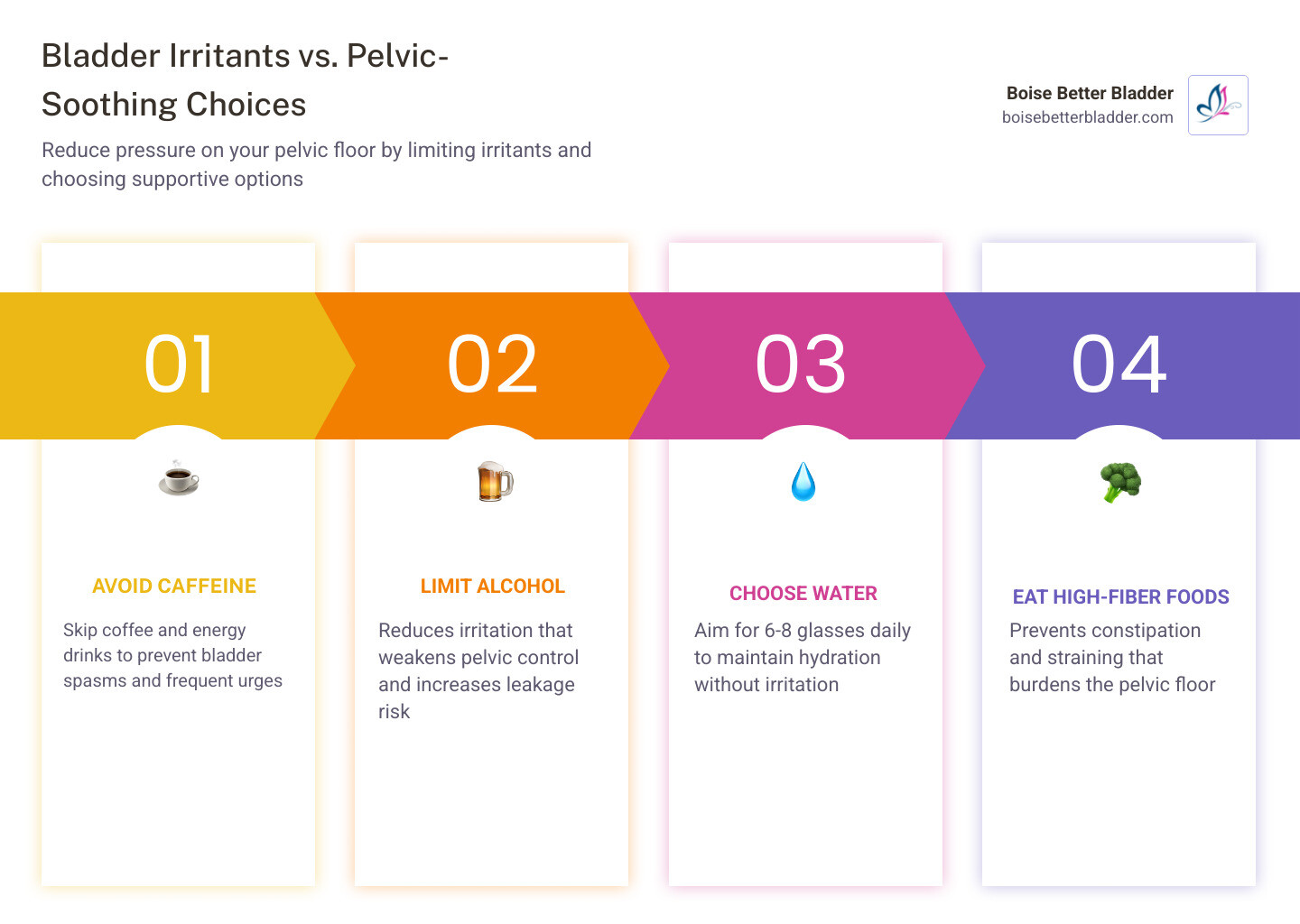
Bladder Irritants (Limit These) Pelvic-Soothing Choices Caffeine (Coffee, Energy Drinks) Water (6-8 glasses daily) Alcohol Herbal Teas (Non-caffeinated) Spicy Foods High-Fiber Foods Carbonated Beverages Magnesium-rich foods
The body works in patterns. Chronic constipation is one of the most common "hidden" causes of pelvic floor weakness. Straining on the toilet puts immense pressure on the pelvic floor, stretching the tissues over time. By increasing fiber and staying hydrated, you allow the pelvic floor to rest.
Furthermore, weight management plays a role. Excess weight around the midsection increases intra-abdominal pressure, which pushes down on the bladder. Similarly, smoking causes a chronic "smoker’s cough," which repeatedly hammers the pelvic floor. For more lifestyle tips, the NHS offers 10 ways to stop leaks that focus on these daily habits.
When to Seek Professional Evaluation and Advanced Care
Sometimes, despite our best efforts with weak pelvic floor exercises, the needle doesn't move. Or perhaps the symptoms—like persistent leakage, a feeling of "heaviness," or pain during intimacy—are too severe to manage at home.
At Boise Better Bladder, we see many women who have "graduated" from traditional physical therapy but still haven't reached their goals. This is where modern technology meets clinical expertise.
Our signature program in Boise utilizes FDA-cleared HIFEM (High-Intensity Focused Electromagnetic) technology. This isn't just a "stronger Kegel." One 30-minute session delivers the equivalent of 25,000 Kegel exercises. It targets the deep tissues that are often difficult to reach through voluntary exercise alone. We combine this with holistic acupuncture to improve nerve communication and circulation.
Bringing it all together. We don't just look at the bladder; we look at the whole person. If you've tried everything else, read our Testimonials to see how other women in the Treasure Valley have regained their freedom.
Recognizing the Signs of a Hypertonic Pelvic Floor
It is vital to mention that not every pelvic floor is "weak." Some are actually hypertonic, meaning they are stuck in a state of over-contraction.
Symptoms: Pelvic pain, difficulty starting urination, or pain during intercourse.
The Trap: If your muscles are already too tight, doing more Kegels can actually make your symptoms worse.
In these cases, the pattern is one of tension, not weakness. We focus on relaxation, nervous system regulation, and "down-training" the muscles before we ever attempt to strengthen them.
Frequently Asked Questions
How long does it take to see results from weak pelvic floor exercises?
Most women begin to notice a decrease in "leaks" or urgency within 4 to 6 weeks of daily practice. However, muscle hypertrophy (building actual muscle mass) and neurological coordination take longer. For major, life-changing functional improvement, you should commit to a routine for 3 to 6 months. As of May 2026, clinical standards emphasize that maintenance is a lifelong journey. You can find more on expectations here: How To Strengthen Your Pelvic Floor.
Can men benefit from these exercises?
Absolutely. While women are more likely to identify and seek treatment for bladder leaks, the anatomy is remarkably similar. Men often require pelvic floor strengthening post-prostate surgery to manage incontinence or to improve erectile function and bowel control.
Are there risks to over-exercising the pelvic floor?
Yes. Just like your biceps, your pelvic floor can suffer from muscle fatigue. If you over-exercise without the relaxation phase, you may notice increased leakage because the muscle is too tired to respond when you actually need it (like when you sneeze). Always listen to your body’s signals.
Conclusion
Your pelvic floor is the foundation of your core, your confidence, and your daily comfort. Whether you are starting with basic weak pelvic floor exercises at home or seeking the advanced support of HIFEM technology and acupuncture, the goal is the same: restoring the natural patterns of your body.
Remember: Symptoms are signals. They are not a life sentence, and they are not a sign that you are "broken." They are simply an invitation to look deeper at the root cause.
If you are ready to stop managing symptoms and start restoring function, we invite you to take the next step. Our team at Boise Better Bladder is here to help you navigate this journey with clinical clarity and empathetic care.
