Stop the Leak and Love Your Core with Meridian Postpartum Pelvic Therapy
Why Postpartum Bladder Leaks Are Signals — Not Sentences
Meridian postpartum pelvic therapy is specialized care designed to help new mothers recover pelvic floor strength, bladder control, and core coordination after childbirth — whether they delivered vaginally or by cesarean.
Quick answers for new mothers in Meridian:
What it is: Targeted therapy to restore the pelvic floor muscles, nerves, and core after pregnancy and delivery
Who it's for: Women experiencing leaks, pelvic pain, core weakness, or discomfort after any type of birth
When to start: Most providers recommend a first evaluation at 6 weeks postpartum
What's available: Traditional pelvic floor physical therapy, non-invasive HIFEM technology (like EMSELLA), and integrative approaches combining acupuncture with neuromuscular re-education
Key conditions addressed: Urinary incontinence, diastasis recti, pelvic organ prolapse, painful intercourse, and scar tissue from C-sections or perineal tears
Here is something worth saying clearly: bladder leaks after having a baby are common — but they are not normal. They are not something you are supposed to simply accept.
Leaking when you laugh, cough, or lift your child is your body sending a signal. It is telling you that something in the pelvic system — the muscles, the nerves, the coordination pathways — is out of balance and asking for support.
Pregnancy places enormous physical demand on the pelvic floor. The weight of a growing baby, hormonal changes that relax ligaments and muscles, and the physical process of delivery all alter how the pelvic floor functions. Even a cesarean birth — often assumed to be "easier" on the pelvic floor — involves surgical disruption to the abdominal wall that affects core and pelvic coordination.
Your body isn't failing you. It's communicating.
The good news is that these patterns can be identified, addressed, and corrected. That is exactly what postpartum pelvic therapy is designed to do.
I'm Dr. Kimberly Thompson, DACM, L.Ac., and over the years I've worked with hundreds of women navigating the exact challenges described above — many of whom were told their symptoms were simply "part of having children." At Boise Better Bladder, my approach to Meridian postpartum pelvic therapy combines advanced neuromuscular technology with acupuncture and holistic care to address the root cause, not just the symptom. Let's look at what's really happening in the postpartum body — and what you can do about it.
Understanding the Postpartum Pelvic Floor: Why Symptoms are Signals
When women in the Treasure Valley experience postpartum leaks, they are often told their pelvic floor muscles are simply "stretched out" or "weak." While muscle laxity is certainly a piece of the puzzle, this standard explanation is fundamentally incomplete.
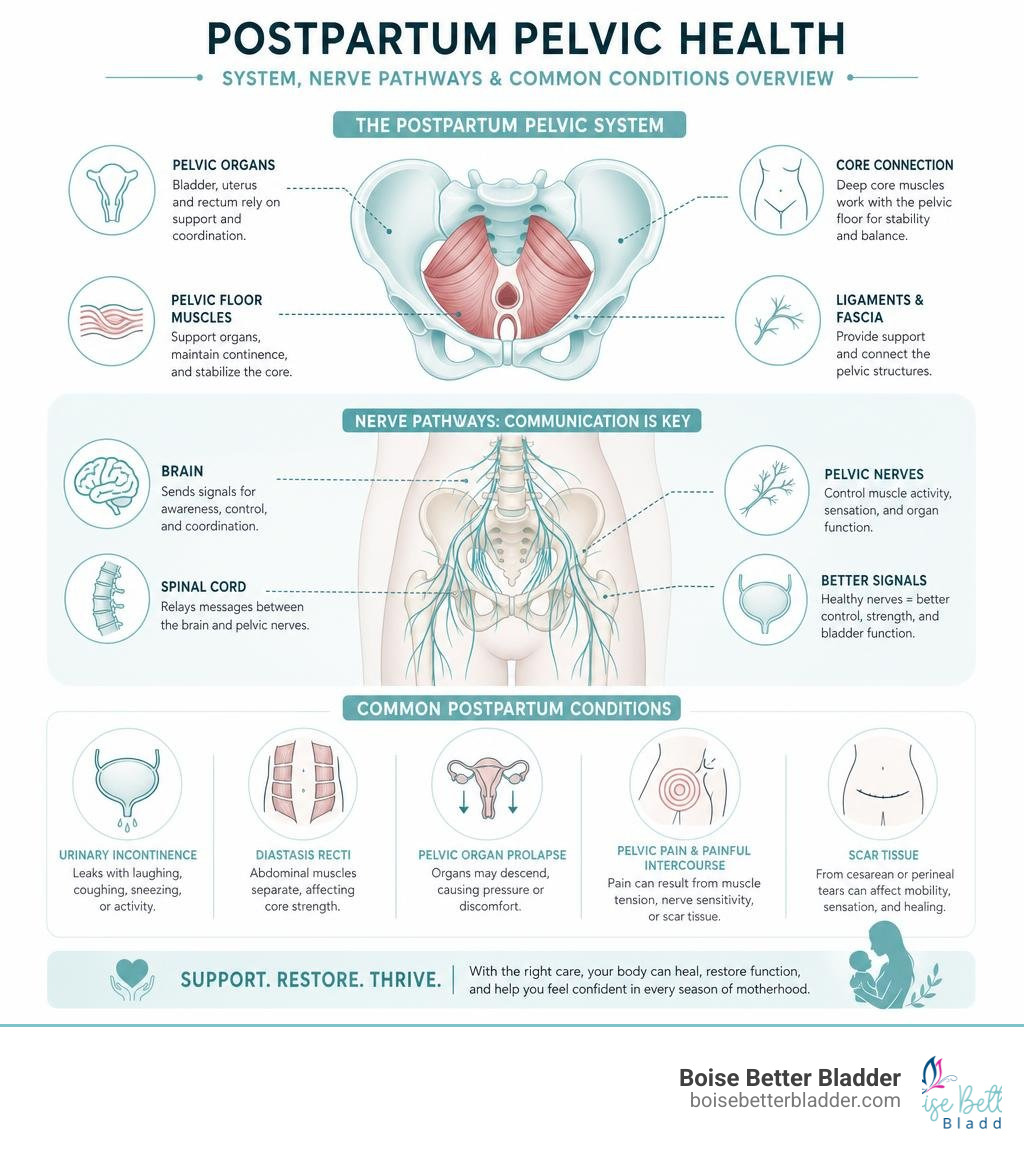
The pelvic floor is not just a hammock of muscle; it is a highly sophisticated, dynamic pressure system. It works in perfect coordination with your diaphragm, your deep abdominal muscles, and your lower back. This system relies on delicate nerve pathways to tell the muscles exactly when to contract, when to relax, and how much tension to hold.
When you experience urinary leakage, pelvic pressure, or pain, your body is not failing.
“Symptoms are signals.”
A leak is a clear, neurological communication that the pelvic pathway is out of balance. This imbalance typically stems from a disruption in three core areas:
Nerve Communication: The pathways that carry signals from the brain to the pelvic floor can become stretched, compressed, or desensitized during pregnancy and labor.
Circulation and Blood Flow: Postpartum healing requires oxygen-rich blood. When local circulation is restricted by scar tissue or pelvic stagnation, tissues remain weak and slow to recover.
Muscular Coordination: Sometimes the muscles aren't too weak; instead, they are too tight (hypertonic) or simply firing out of sequence with your breathing.
To find lasting relief, we must look beyond the surface and address these deeper energetic and physical patterns. For a more comprehensive look at these dynamics, read our guide on Postpartum Incontinence Help.
The Impact of Childbirth on Pelvic Pathways
Whether you had a vaginal delivery or a cesarean birth (often referred to as a "belly birth"), your pelvic pathways undergo significant structural changes.
During a vaginal delivery, the levator ani muscle — the primary muscle supporting your pelvic organs — is subjected to intense stretch and pressure. In many cases, perineal tearing or an episiotomy occurs, leaving behind scar tissue that can restrict movement and create localized muscle spasms. This scar tissue directly interferes with the natural sliding mechanics of the pelvic muscles, leading to localized pain or a feeling of constant pelvic heaviness.
In contrast, a C-section bypasses the vaginal canal but directly disrupts the lower abdominal wall. The surgical incision cuts through layers of skin, fascia, and tissue, which can lead to deep scar tissue formation. This surgical scar often binds to surrounding tissues, disrupting the core’s pressure management system and altering the nerve signaling pathways that connect the lower abdominals to the pelvic floor.
Both birth experiences alter the body's natural signaling pathways. Without targeted rehabilitation, these disrupted pathways can lead to long-term pelvic floor dysfunction. Restoring these pathways requires a dedicated approach that addresses both the physical tissues and the underlying nervous system communication.
Restoring Balance with Meridian Postpartum Pelvic Therapy
To truly heal, we must shift our perspective from managing symptoms with pads to actively restoring systemic balance.
“The body works in patterns.”
When we look at pelvic health through both a modern neurological lens and the timeless principles of meridian therapy, we see that the pelvic floor is deeply connected to the body’s overall vitality, circulation, and nervous system regulation. Restoring this balance requires a holistic approach that addresses both local muscle coordination and the broader pathways of the nervous system. You can explore how we approach this integrated care by reading about Pelvic Floor Physical Therapy Boise.
Addressing Diastasis Recti and Core Coordination
Many postpartum women in Meridian, Eagle, and Nampa struggle with diastasis recti abdominis (DRA) — the separation of the abdominal muscles along the midline. When the abdominal wall is separated, the core loses its ability to manage intra-abdominal pressure effectively. Every time you cough, sneeze, or lift your baby, that pressure has to go somewhere. If the abdominal wall cannot support it, the pressure is pushed directly down onto the pelvic floor, frequently resulting in leaks.
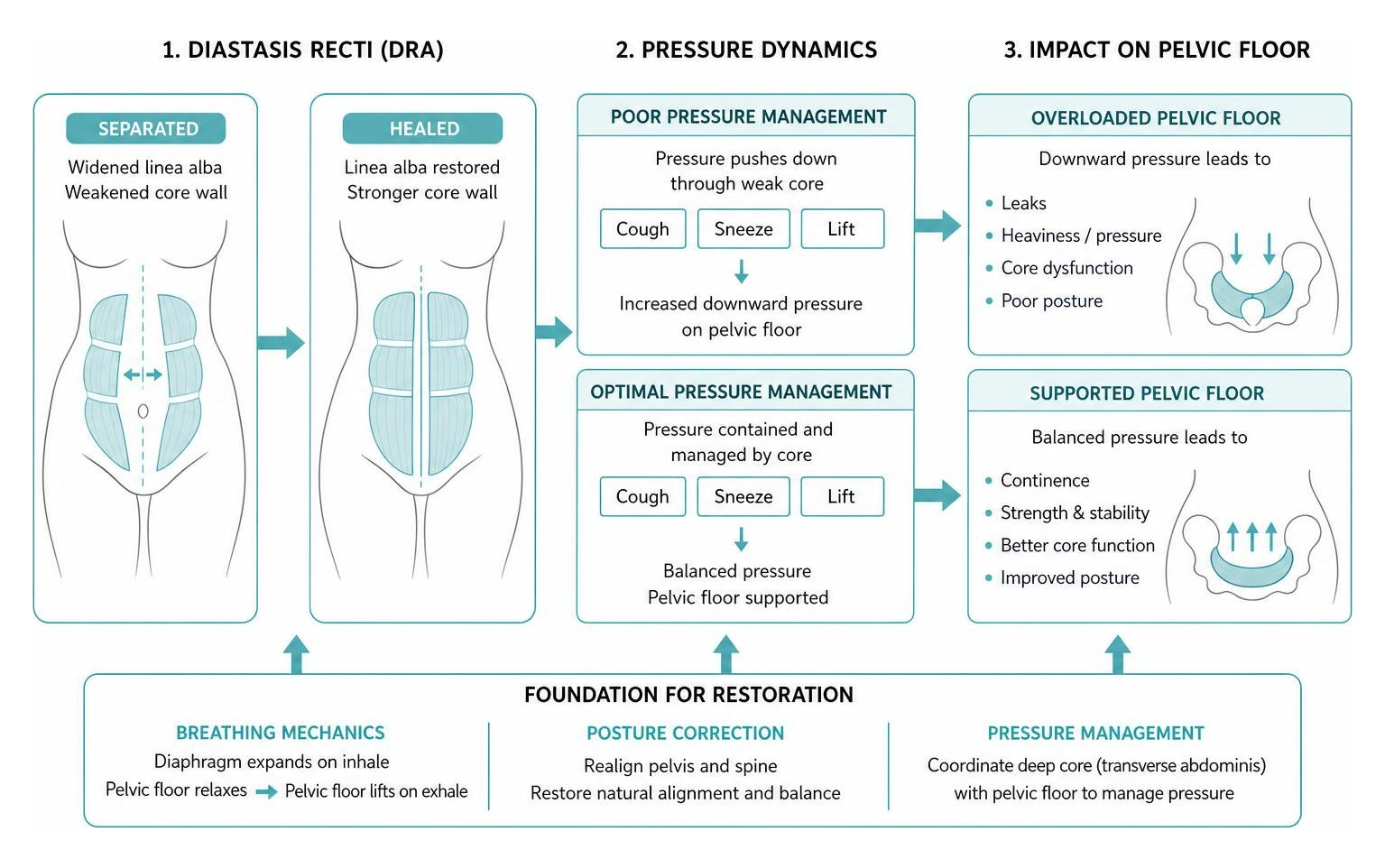
Restoring core coordination involves:
Breathing Mechanics: Retraining the diaphragm to expand naturally, allowing the pelvic floor to relax on the inhale and gently lift on the exhale.
Posture Correction: Realigning the pelvis and spine after months of carrying a baby's weight, which naturally shifts your center of gravity.
Pressure Management: Learning how to engage the deep transverse abdominis muscles in synergy with the pelvic floor to prevent downward pressure.
By focusing on these patterns, we can rebuild a strong foundation from the inside out. For practical guidance on stabilizing your core at home, see our suggested Pelvic Floor Exercises for Women.
Overcoming Postpartum Incontinence and Pelvic Pain
A common clinical misconception is that postpartum pelvic pain and incontinence are always caused by weak muscles. Because of this, many women are told to "just do Kegels." However, if your pelvic floor muscles are hypertonic — meaning they are constantly held in a state of high tension or spasm — performing repetitive squeezes will only worsen the imbalance.
Hypertonic muscles are tired, stiff, and lack the dynamic range of motion required to contract quickly when you sneeze or jump. This can lead to a frustrating combination of both urinary leaks and pelvic discomfort, including:
Pelvic Organ Prolapse: A feeling of heaviness or "falling out" due to laxity or poor pressure management.
Dyspareunia: Painful intimacy, often caused by tight muscles and scar tissue around vaginal tears.
Muscle Spasms: Sharp or aching pain in the pelvis, tailbone, or lower back.
To heal, we must move beyond standard repetitive exercises and teach these muscles how to fully release, coordinate, and strengthen within their full range of motion. If you are struggling with these symptoms, explore our guide on Weak Pelvic Floor Exercises to understand how to safely begin your recovery.
Modern Pathways to Healing: Beyond Traditional Kegels
For many postpartum mothers, traditional repetitive exercises fail to restore function because the underlying nerve communication is disrupted. If the brain cannot send a clear, strong signal to the pelvic floor, trying to perform manual exercises is like trying to turn on a light bulb when the wiring is damaged.
To bridge this gap, we utilize advanced, non-invasive technology combined with holistic care to restore neuromuscular control and accelerate tissue healing.
Feature | Traditional Pelvic Exercises (Kegels) | Non-Invasive HIFEM Therapy (Our Signature Program) |
|---|---|---|
Muscle Contractions | Variable, often hard to perform correctly | Up to 25,000 deep, involuntary contractions |
Duration | Requires daily, long-term commitment | 30-minute sessions over a few weeks |
Neuromuscular Focus | Rely on damaged or stretched nerve pathways | Actively re-educates and restores nerve pathways |
Comfort Level | Can be tedious or cause strain if done wrong | Fully clothed, comfortable, and completely non-invasive |
Peak Effectiveness | Often takes months to see minor changes | Noticeable improvements within 8 to 12 weeks |
To understand how these modern approaches differ from traditional physical therapy, read about Pelvic Muscle Strengthening.
Non-Invasive Neuromuscular Re-education
At Boise Better Bladder, we utilize High-Intensity Focused Electromagnetic (HIFEM) technology to provide deep, effortless neuromuscular re-education. While standard EMSELLA chairs in general clinics deliver 12,000 contractions per session, our specialized, signature system delivers the equivalent of 25,000 deep pelvic floor contractions in a single, comfortable 30-minute session.
This advanced technology works by sending targeted electromagnetic waves directly into the pelvic floor muscles while you remain fully clothed. These waves trigger supramaximal contractions — contractions that are physically impossible to achieve through voluntary effort alone.
This process achieves several critical healing goals:
Neuromuscular Re-education: It forces the brain and pelvic nerves to rebuild strong, clear communication pathways.
Rapid Muscle Recovery: By contracting the muscles deeply and uniformly, it increases blood flow and oxygenation to the pelvic tissues, accelerating postpartum tissue healing.
Collagen Production: The deep stimulation triggers the production of new collagen and fibroblasts, helping to restore the structural integrity of the vaginal and pelvic tissues.
Clinical studies show that 95% of patients report an improved quality of life and a 75% pad reduction after completing a standard series of treatments. To learn more about how this breakthrough technology can help you, read our detailed article on Understanding Weak Pelvic Floor Treatment.
Integrating Meridian Postpartum Pelvic Therapy with Holistic Care
What makes our approach in the Treasure Valley truly unique is how we combine modern HIFEM technology with targeted acupuncture techniques.
Acupuncture is an exceptional tool for regulating the nervous system, reducing pelvic muscle spasms, and improving localized blood flow. By placing gentle, sterile needles along specific meridian pathways, we can:
Enhance Nerve Communication: Calm an overactive bladder and restore balanced signaling to the pelvic floor.
Improve Circulation: Bring fresh, nutrient-rich blood to C-section scars and perineal tears, helping to soften rigid scar tissue.
Regulate the Nervous System: Shift the body out of a stressed "fight-or-flight" state and into a "rest-and-heal" state, which is essential for systemic recovery.
By combining muscle strengthening with improved nerve communication and circulation, our program supports long-term results — not just temporary relief. Discover the benefits of this combined approach in our overview of Pelvic Muscle Therapy.
What to Expect in Your Postpartum Recovery Journey
We believe that your postpartum recovery should be a warm, supportive, and completely stress-free experience. When you visit us, you won't have to worry about invasive internal exams or uncomfortable physical therapy.

During your initial consultation, we will sit down to discuss your pregnancy, birth experience, and specific recovery goals. We look at your body as a whole, evaluating your breathing patterns, core stability, and pelvic symptoms. From there, we design a customized recovery plan tailored to your unique postpartum timeline, helping you return to walking along the Boise River, playing with your kids, and exercising with confidence.
Navigating Your Meridian Postpartum Pelvic Therapy Timeline
Postpartum recovery is a journey that unfolds in natural phases. Understanding this timeline can help you set realistic expectations for your body:
Weeks 2–4 (Early Recovery): The focus is on gentle rest, diaphragmatic breathing, and allowing initial tissue healing to occur.
Week 6 (The Healing Milestone): This is the ideal window to schedule your initial pelvic floor and core assessment to check for diastasis recti, scar tissue, and coordination.
Weeks 8–12 (Active Rehabilitation): Utilizing targeted HIFEM sessions and acupuncture to rebuild deep muscle strength and restore bladder control.
Week 12 and Beyond (Return to Exercise): Performing a comprehensive screen to ensure your core and pelvic floor can safely manage high-impact activities like running or weightlifting.
Frequently Asked Questions About Postpartum Pelvic Recovery
When should I start pelvic therapy after childbirth?
We generally recommend waiting until you are at least 6 weeks postpartum before starting active pelvic floor therapy. This gives your body time to complete its initial acute healing phase and allows any perineal or C-section incisions to close fully. However, you can begin gentle diaphragmatic breathing and posture awareness at home during the first few weeks after birth.
This timing also fits with the broader medical understanding that postpartum recovery is not just a single visit, but an ongoing process. The American College of Obstetricians and Gynecologists describes postpartum care as an ongoing process, which is why symptoms like leaking, pressure, or pelvic pain deserve thoughtful follow-up rather than being dismissed as expected.
Is pelvic floor therapy covered by insurance in Meridian?
Coverage for postpartum pelvic recovery varies depending on your specific insurance provider and the type of treatment you choose. Traditional physical therapy clinics in Meridian often accept standard health insurance, though patients may face high deductibles or co-pays.
At Boise Better Bladder, we focus on providing highly specialized, non-invasive programs that combine advanced technology with holistic care. While we do not bill insurance directly, many of our patients successfully utilize their Health Savings Accounts (HSA) or Flexible Spending Accounts (FSA) to cover the cost of their care. We are happy to provide detailed receipts and documentation to help you maximize your benefits.
Can pelvic therapy help if I gave birth years ago?
Yes, absolutely. It is a common myth that postpartum pelvic therapy is only useful in the immediate months after childbirth. In reality, we frequently help women who gave birth 10, 20, or even 30 years ago.
Your pelvic floor muscles retain muscle memory, and tissues are capable of adapting and strengthening at any stage of life. If you have been living with bladder leaks or pelvic discomfort since your children were young, please know that you do not have to live with these symptoms forever. It is never too late to restore balance.
Conclusion: Reclaiming Your Core and Confidence
Your postpartum journey should be filled with joy, connection, and a growing sense of strength — not limited by the constant worry of bladder leaks or pelvic pain. Your body is not failing; it is simply asking for a return to balance.
By combining the power of modern electromagnetic technology with the time-tested pathways of acupuncture, we can help you rebuild your core, stop the leaks, and reclaim your active lifestyle.
If you are ready to move past temporary fixes and address the root cause of your symptoms, we invite you to take the first step. Learn more about our background on our About Us page, or reach out to us directly through our Contact Us page to schedule your personalized evaluation.
