
How to Find the Best Incontinence Treatment in Nampa
Why So Many Nampa Women Are Quietly Searching for Bladder Leak Solutions
Incontinence treatment in Nampa is more accessible than most women realize — and far more effective than pads, pills, or simply "managing" the problem.
If you're looking for a quick overview of your options:
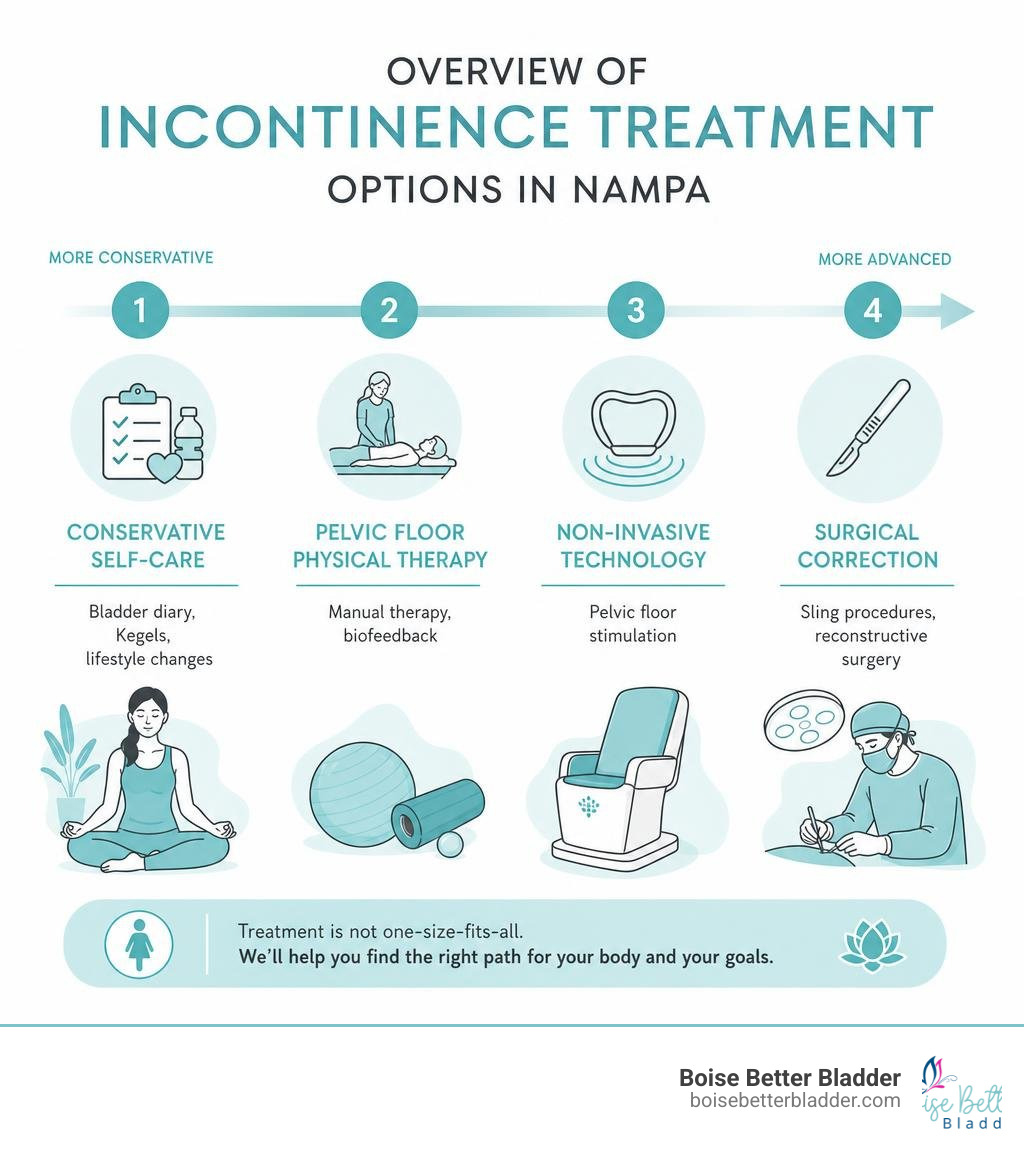
Treatment Type | Examples | Invasiveness | Typical Cost Range |
|---|---|---|---|
Non-invasive technology | HIFEM (pelvic floor stimulation) | None | From $2,550 |
Pelvic floor physical therapy | Manual therapy, biofeedback | Low | Varies by provider |
Conservative self-care | Bladder diary, Kegels, lifestyle changes | None | Low/free |
Surgical correction | Sling procedures, reconstructive surgery | High | $6,700 – $18,400 |
Most women reading this have already tried the basics. Maybe Kegel exercises didn't stick. Maybe physical therapy felt uncomfortable or didn't deliver lasting results. Maybe a doctor suggested surgery felt like the only path forward — and that didn't sit right with you.
Here is what I want you to understand before anything else: bladder leaks are not a personal failure. They are a signal. Your body is communicating that something in the coordination between your pelvic floor muscles and your nervous system needs attention. That's not something you have to simply accept.
Approximately 75% of women experiencing bladder leakage never even bring it up with their doctor. If you're here, you're already ahead of most — and you deserve clear, honest information about what actually works.
I'm Dr. Kimberly Thompson, DACM, L.Ac., and I've worked with hundreds of women navigating incontinence treatment in Nampa and the broader Treasure Valley — many of whom came to me after years of frustration with treatments that only masked their symptoms. My approach combines advanced pelvic floor technology with acupuncture and holistic care to address the root cause of bladder leaks, not just the inconvenience of them.
Understanding Bladder Leakage: Symptoms are Signals
When we experience a physical symptom like bladder leakage, our modern medical system often tells us to treat it as an isolated mechanical failure. We are told the pelvic floor is simply "weak," or that the bladder is "hyperactive." But as a clinician, I look at the body through the lens of pattern recognition.
Symptoms are signals.
Your bladder does not operate in a vacuum. It relies on a sophisticated web of pelvic floor muscles, connective tissues, and nerve pathways that communicate constantly with your brain. When we experience bladder leakage, it is rarely just a localized muscle issue; it is a breakdown in this vital communication pathway.
To find the right incontinence treatment Nampa offers, we must first understand the specific pattern your body is expressing.
Stress Urinary Incontinence and Physical Pressure
Stress urinary incontinence (SUI) is the most common form of bladder leakage in women, affecting millions of individuals across the United States. This pattern occurs when physical pressure is exerted on the bladder — such as when you laugh, sneeze, cough, jump, or lift something heavy — and the pelvic floor muscles fail to contract quickly or strongly enough to keep the urethra closed.
We often see women who struggle with stress urinary incontinence find that their leaks worsen during specific times. For instance, did you know that SUI can naturally worsen during the week before your menstrual period? This happens because falling estrogen levels reduce the blood flow and muscular pressure around the urethra, making it physically harder for the tissue to seal shut.
When the structural integrity of the pelvic floor is compromised due to childbirth, aging, or hormonal shifts, the body loses its natural shock-absorbing capacity. While traditional options include wearing protective pads or inserting temporary devices like a vaginal pessary, these are management tools rather than cures. To truly resolve stress leaks, we must explore non-surgical, non-invasive pathways that restore the structural integrity and automatic firing of these deep pelvic muscles.
Urge Incontinence and Overactive Bladder Patterns
If stress incontinence is a mechanical support issue, urge incontinence is a communication error.
Urge incontinence — often referred to as overactive bladder (OAB) — is characterized by a sudden, intense, and uncontrollable need to urinate, often followed by involuntary leakage. This pattern is driven by inappropriate spasms or contractions of the detrusor muscle (the muscle that wraps around the bladder).
The body works in patterns.
For many women, these spasms are triggered by sensory cues: the sound of running water, putting your key in the front door, or transitioning from a warm car into the cold Idaho air. Clinically, we define urinary frequency as needing to empty your bladder more than eight times a day or waking up more than twice a night to urinate.
This hyper-reactivity is a sign that the nervous system is stuck in an overactive loop. The bladder is sending "full" signals to the brain far too early, and the brain is responding by telling the bladder to contract. If you are experiencing this pattern, you can read more about how we calm these signals through targeted Overactive Bladder Treatment.
Mixed and Overflow Incontinence Pathways
For many women in Nampa, bladder issues do not fit neatly into a single box. It is highly common to experience mixed incontinence, which is a combination of both stress and urge patterns. You might leak when you sneeze, but also find yourself rushing to the bathroom with sudden urgency. This indicates that both the structural support system and the neurological communication pathways require attention.
Less common in women, but still important to recognize, is overflow incontinence. This occurs when the bladder cannot empty completely, leading to constant dribbling or small leaks. This often stems from a physical blockage or a weakened detrusor muscle that has lost its ability to contract effectively, frequently due to nerve damage or long-term habit patterns of "holding it" too long.
When multiple patterns overlap, it is a clear message that the entire pelvic ecosystem — muscles, nerves, and circulation — is out of balance.

Navigating Your Options for Incontinence Treatment Nampa
The healthcare landscape in Nampa and the surrounding Treasure Valley offers a wide array of options for bladder care. However, navigating these choices can feel overwhelming. The key to finding the right path is understanding the difference between managing your symptoms and treating the root cause.
Conservative and Non-Invasive Incontinence Treatment Nampa Options
When women first seek incontinence treatment Nampa solutions, conservative therapies are widely recognized as the safest first-line approach. These methods aim to restore pelvic function without the risks of surgery or the side effects of prescription medications.
Traditional conservative care often starts with:
Lifestyle modifications: Restricting bladder-irritating liquids like coffee, black tea, and alcohol, and managing fluid intake before bedtime.
Bladder diaries: Tracking your voiding patterns and systematically training your bladder to increase the intervals between bathroom visits.
Manual exercises: Practicing pelvic floor exercises to build strength, which you can learn more about in our guide to Pelvic Floor Exercises for Women.
While these lifestyle changes are helpful, they require immense discipline and often fall short for women with moderate to severe leakage. This is where modern, non-invasive neuromuscular re-education comes in. By using advanced technology to stimulate and rebuild the pelvic floor muscles automatically, we can achieve therapeutic results that are simply impossible to replicate with manual home exercises alone.
Understanding the Limitations of Invasive Interventions
When conservative options fail to provide relief, many traditional urologists and urogynecologists recommend surgical interventions. The most common of these is the mid-urethral sling procedure.
During a sling surgery, a surgeon implants a synthetic mesh or biologic tissue under your urethra to act like a hammock, keeping the airway closed during moments of physical exertion. While studies show that specialized procedures like the Altis® sling have high initial success rates — with 90.4% of women stating they feel much better after two years — surgery is not a permanent guarantee.
There are several critical limitations to consider before choosing an invasive path:
Pregnancy negation: If you plan on having children in the future, a subsequent pregnancy and vaginal delivery can completely negate the physical effects of a surgical sling, causing your incontinence to return.
Surgical risks: Any invasive procedure carries risks of infection, chronic pelvic pain, bladder injury, and mesh erosion (where the synthetic mesh slowly wears through the vaginal wall).
Strict recovery timelines: Post-surgery recovery requires avoiding all heavy lifting, strenuous exercise, and sexual intercourse for at least six weeks to allow the tissue to heal around the mesh.
No effect on urgency: A surgical sling only addresses the mechanical structure of stress incontinence. It does not treat overactive bladder or urge patterns.
For these reasons, many women in Nampa are actively seeking drug-free, non-surgical alternatives that restore the body's natural strength without the need for anesthesia or incisions.
Traditional Pelvic Therapy vs. Modern Non-Invasive Alternatives
If you have looked into non-surgical options, you have likely heard of pelvic floor physical therapy. While traditional physical therapy is an excellent tool, it is helpful to compare what it involves with modern, passive technological alternatives so you can choose the approach that best fits your lifestyle and comfort level.
What to Expect with Traditional Pelvic Evaluations
Traditional pelvic floor physical therapy is highly clinical. During a comprehensive initial evaluation, a physical therapist will review your complete medical, surgical, and obstetric history.
Because the pelvic floor sits inside the pelvis, a thorough traditional assessment typically includes:
An examination of your general posture, core strength, and abdominal wall.
An external assessment of the pelvic tissues and perineum.
An internal pelvic muscle assessment (performed vaginally or rectally with your explicit consent) to manually test muscle strength, tone, and coordination.
For many women, the prospect of an internal physical exam can be a source of anxiety or discomfort, particularly if they are already dealing with pelvic pain or past trauma. This clinical barrier is one of the primary reasons women delay seeking help. Fortunately, you can learn more about how traditional clinical care is structured by reading about Pelvic Floor Physical Therapy Boise, which helps illustrate why so many patients are relieved to find comfortable, non-invasive alternatives that do not require undressing or internal exams.
How Non-Invasive Technology Restores Muscle Coordination
Your body isn’t failing you. It has simply lost its coordinate patterns.
Traditional Kegel exercises are incredibly difficult to perform correctly. In fact, studies show that a large percentage of women who attempt manual pelvic exercises are actually contracting the wrong muscles (like the inner thighs or glutes) or pushing down instead of lifting up.
Modern non-invasive technology, such as High-Intensity Focused Electromagnetic (HIFEM) therapy, bypasses this human error entirely. By utilizing a specialized therapeutic chair, HIFEM technology projects targeted electromagnetic waves directly into the pelvic floor.
This technology achieves what we call supramaximal contractions — muscle contractions that are far deeper and more intense than anything you could produce voluntarily. A single 28-minute session delivers the equivalent of 25,000 perfect Kegel exercises. This rapid, passive stimulation re-educates the muscles, builds core stability, and restores the brain-bladder connection without pain or physical exertion.
To understand how this deep cellular retraining works to resolve leaks, explore our detailed breakdown of Understanding Weak Pelvic Floor Treatment.
Comparing the Costs of Bladder Care in Nampa
When evaluating incontinence treatment Nampa options, financial transparency is essential. Many women do not realize how much they are spending on temporary "solutions" like pads and liners, nor do they realize the wide price variance in local medical procedures.
As of July 2026, let's look at the financial reality of different care pathways in Nampa, Idaho:
Care Pathway | Direct Costs | Hidden / Ongoing Costs | Time Investment |
|---|---|---|---|
Routine Pad Management | $900 annually (for severe incontinence) | Skin irritation creams, ruined clothing, emotional stress | Lifetime of purchasing and changing pads |
Traditional Pelvic PT | $150 – $250 per session (co-pays apply) | Travel time, at-home "homework" exercises daily | 8 to 12 weeks of weekly clinical visits |
Surgical Correction | $10,872 average (range: $6,700 – $18,400) | Anesthesia fees, facility fees, lost wages during recovery | 6 weeks of strict physical restrictions |
Boise Better Bladder Program | Programs start at $2,550 (HSA/FSA eligible) | Maintenance sessions (1-2 times per year, if needed) | 4 weeks (8 sessions total, 30 mins each) |
The Financial Reality of Surgical vs. Conservative Care
In Nampa, the median cost of surgical urinary incontinence treatment across the 16 primary medical providers who perform these procedures is $10,872. Depending on the surgical center and your insurance deductible, out-of-pocket costs for a surgical sling can range from $6,700 to as high as $18,400.
Furthermore, women with severe bladder leaks spend an average of $900 annually on routine care, including disposable pads, liners, specialty undergarments, and skin creams. Over a decade, that is $9,000 spent simply on hiding the problem, with zero improvement in bladder function.
When you compare these figures, a structured, non-invasive restoration program is not only a safer physical option — it is also a highly cost-effective long-term financial investment.
Choosing the Right Specialist for Your Pelvic Health
Finding the right professional to guide your recovery is a deeply personal decision. In Nampa, there are approximately 219 doctors within a 12-mile radius who treat urinary incontinence, with an average patient rating of 4.1 stars.
Navigating Providers: Finding a Whole-Body, Non-Invasive Approach
When seeking care, you will encounter several types of specialists:
Urologists: Medical doctors who specialize in the urinary tract system for both men and women. They are highly trained in surgical interventions and pharmaceutical management.
Urogynecologists: Gynecologists who have completed fellowship training in pelvic reconstructive surgery. They focus specifically on female pelvic floor disorders, including prolapse and incontinence.
Holistic Pelvic Health Clinicians: Practitioners who look at the whole body, focusing on physical medicine, nervous system regulation, and non-invasive therapies to restore natural function.
While surgeons are vital for complex structural cases (such as severe pelvic organ prolapse), we believe in a collaborative, patient-centered approach. Shared decision-making means exploring the least invasive, most natural pathways first.
If your goal is to avoid surgery, synthetic mesh, and the side effects of daily bladder medications, you should seek out a specialist who looks at your body as an interconnected system. We focus on restoring the natural communication between your nerves and muscles rather than simply patching over a symptom.
Frequently Asked Questions About Incontinence in Nampa
How do I find the right provider for urinary incontinence in the Nampa area?
When searching for a provider, look beyond basic star ratings. Seek out clinics that specialize specifically in pelvic health and offer a clear, structured treatment program. Ask potential providers if they offer non-invasive options, how they measure progress, and whether their treatments address both muscle strength and nervous system communication.
Are there non-invasive, FDA-cleared technologies available for bladder control?
Yes! High-Intensity Focused Electromagnetic (HIFEM) technology is an FDA-cleared, clinically proven method for treating urinary incontinence. During this treatment, you remain fully clothed and sit comfortably in a specialized therapeutic chair.
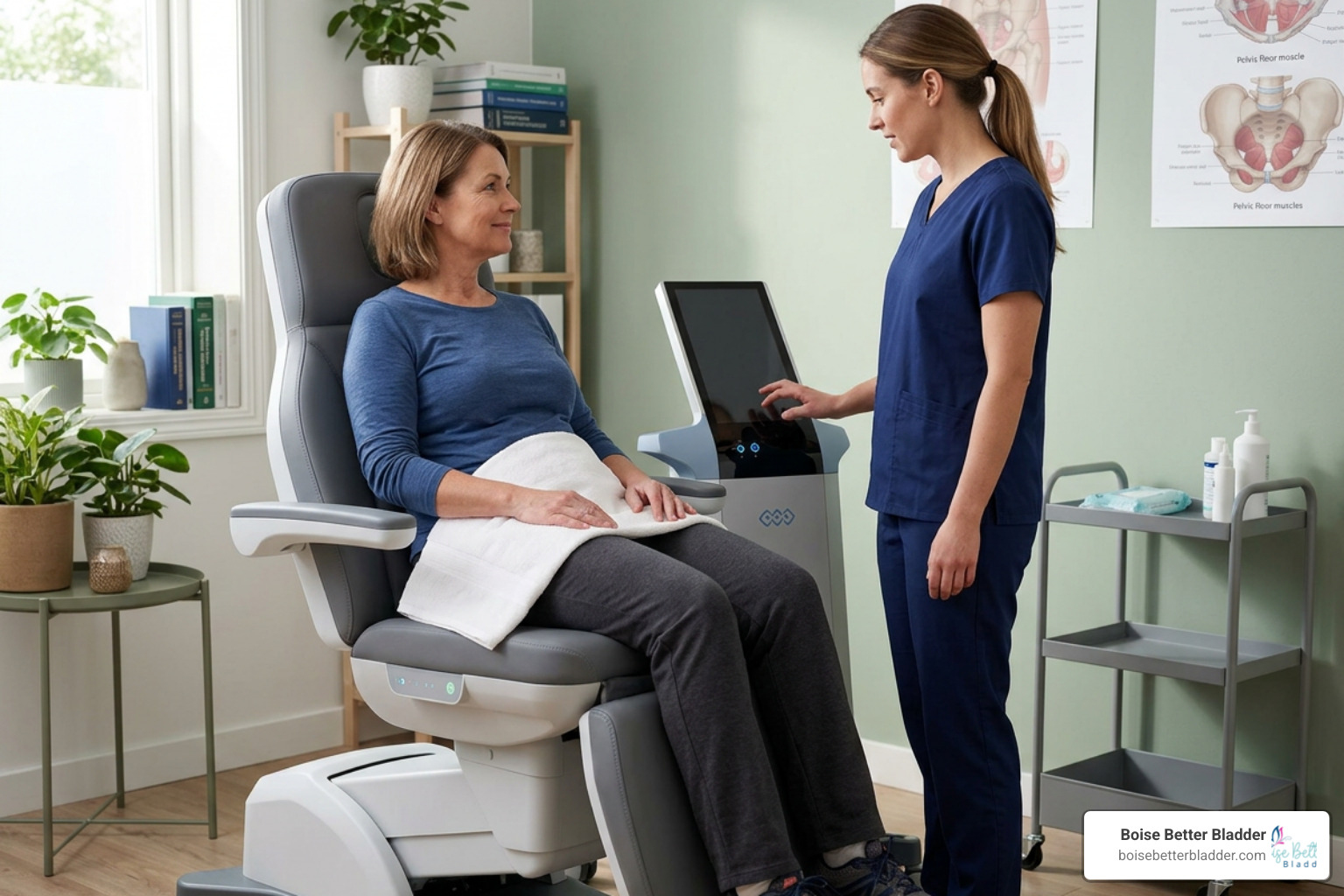
The chair delivers targeted electromagnetic waves that trigger deep, therapeutic pelvic floor contractions. Clinical studies have shown that 95% of participants report a significant improvement in their quality of life, and two-thirds are able to completely eliminate or drastically reduce their use of urinary pads.
Can hormonal changes like menopause make bladder leaks worse?
Absolutely. Estrogen plays a vital role in maintaining the thickness, elasticity, and blood flow of the urethral and vaginal tissues. During menopause, or even during the week before your menstrual cycle, drop-offs in estrogen levels reduce the muscular pressure around your urethra, making physical leaks much more likely. Addressing tissue health and circulation is a key part of holistic pelvic restoration.
Conclusion: Reclaiming Your Flow and Freedom
Your body isn’t failing you. It is simply asking for a different approach.
For too long, women have been told that bladder leaks are an inevitable tax we must pay for childbirth, aging, or hormonal transitions. We are told to accept the daily inconvenience of pads, the potential complications of surgery, or the side effects of pills.
But there is a better way. By understanding the patterns of your body and restoring the natural pathways of communication between your nervous system and your pelvic floor, you can reclaim your confidence and your freedom.
A Holistic Path to Pelvic Restoration
At Boise Better Bladder, we see you as a whole person, not just a medical condition. Our signature program combines advanced, FDA-cleared HIFEM technology — delivering 25,000 perfect pelvic floor contractions in a single, comfortable, fully-clothed 30-minute session — with holistic acupuncture diagnostics and nerve stimulation.
We address both the physical strength of your pelvic muscles and the neurological signals that control them, helping you achieve lasting results without surgery, drugs, or invasive physical therapy.
If you are ready to stop worrying about the nearest bathroom and start living freely again, we invite you to explore How It Works or Contact Us today to schedule your private consultation and complimentary technology demo.
Your path to a stronger, leak-free life starts at the Boise Better Bladder Program. Let's help your body find its natural balance again.
