The Ultimate Guide to Caldwell Incontinence Treatment and HIFEM Technology
Bladder Leaks Are Not Inevitable — Here's What Caldwell Women Need to Know

If you're exploring caldwell incontinence treatment options, here is a quick overview of what's available and what actually works:
Quick Answer: Caldwell Incontinence Treatment Options
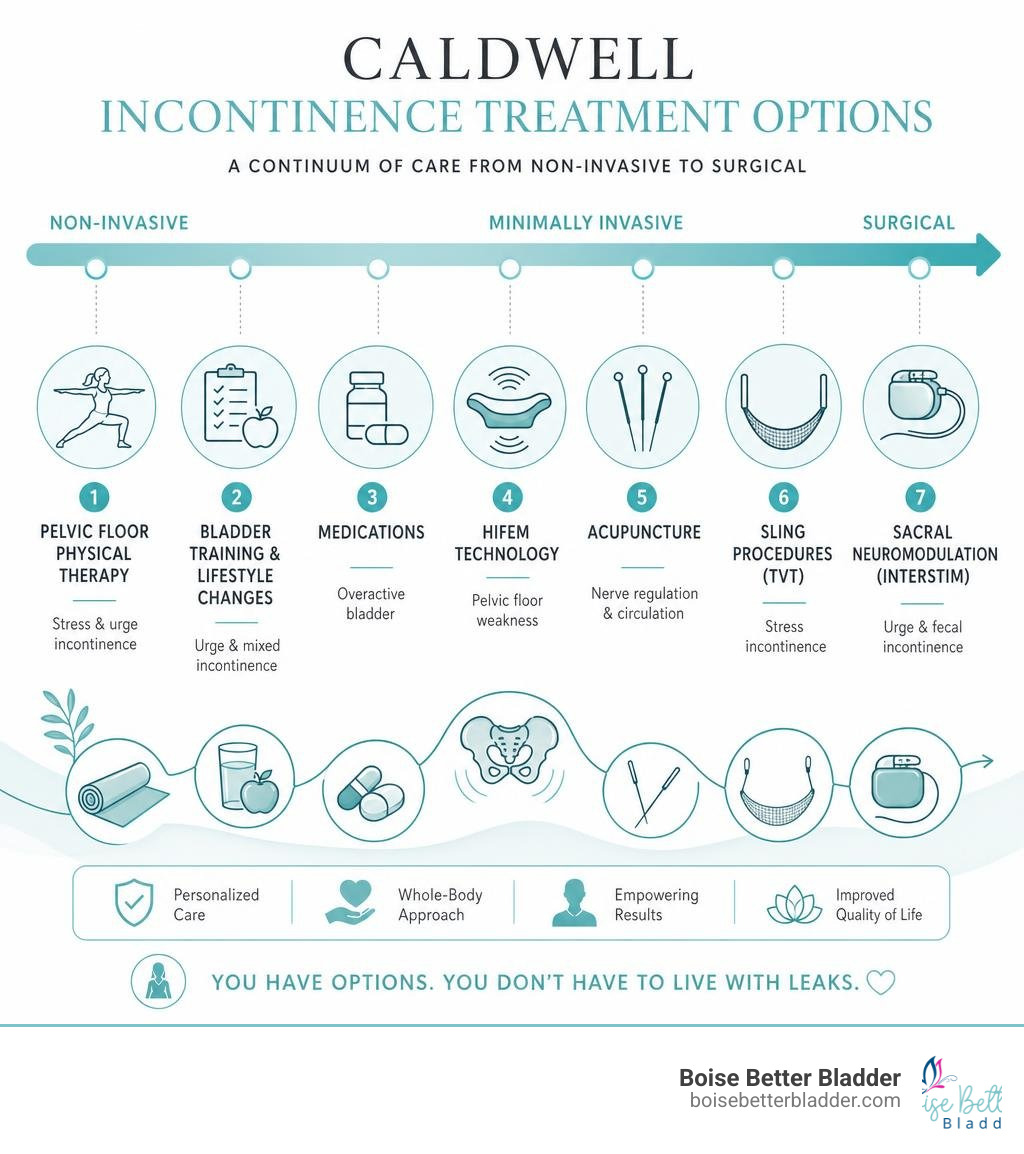
Treatment Type Best For Invasiveness Pelvic floor physical therapy Stress & urge incontinence Non-invasive Bladder training & lifestyle changes Urge & mixed incontinence Non-invasive Medications Overactive bladder Non-invasive HIFEM technology Pelvic floor weakness Non-invasive Acupuncture Nerve regulation & circulation Minimally invasive Sling procedures (TVT) Stress incontinence Surgical Sacral neuromodulation (InterStim) Urge & fecal incontinence Surgical
Let me reframe something important before we go any further.
Bladder leakage is not a normal part of aging. It is not something you simply have to accept. And it is almost certainly not a sign that your body is broken.
Around 33 million people in the United States experience urinary urgency, frequency, and leakage. About 1 in 12 adults struggles with fecal incontinence. These numbers tell us one thing clearly: you are not alone, and this is a recognized, treatable medical condition.
What most women are never told is this — incontinence is usually a communication problem. Your muscles, nerves, and brain are not coordinating the way they should. That breakdown has a pattern. And patterns can be understood, addressed, and often reversed.
Symptoms are signals. Your body is asking for support, not surgery.
Whether you've already tried Kegels, pelvic floor therapy, or medications without lasting results — or you're just beginning to look for answers — this guide walks you through the full landscape of what modern incontinence care looks like in Caldwell, including options that many women have never been told exist.
I'm Dr. Kimberly Thompson, DACM, L.Ac., and I've spent years helping women navigate caldwell incontinence treatment through an integrative approach that combines advanced HIFEM technology with acupuncture and whole-body pelvic health care. I've worked with hundreds of women who were told surgery was their only option — and helped them find a very different path forward.
Understanding Bladder Signals: How Incontinence is Diagnosed and Categorized
When you first experience bladder leaks, the standard medical response is often to treat the bladder as an isolated, mechanical storage tank. If it leaks, the assumption is either that the "door" is weak or the "sensor" is broken.
This explanation is incomplete.
The bladder does not exist in a vacuum. It is suspended within a web of connective tissue, supported by a hammock of pelvic floor muscles, and controlled by a highly complex network of nerves that communicate constantly with your brain.
The body works in patterns.
To understand why your bladder is signaling, we must first look at the pattern of your symptoms. In clinical practice, we categorize these signals into three primary patterns:
Stress Incontinence
This pattern is characterized by physical pressure overcoming the physical resistance of the pelvic floor. When you laugh, sneeze, cough, jump, or lift something heavy, a small amount of urine escapes. This pattern is common after the structural changes of pregnancy, childbirth, or hormonal shifts during menopause. It indicates that the supportive tissues and muscles have lost their tone and coordination.
Urge Incontinence
Often referred to as an overactive bladder (OAB), this pattern is a hyper-communication issue. The nervous system misfires, sending a sudden, intense signal to your brain that you must urinate immediately—even when your bladder is nearly empty. If you have ever felt a sudden leak trigger when you hear running water or put your keys in the front door, you have experienced this neurological misfire.
Mixed Incontinence
Many women do not fit neatly into one box. They experience a complex pattern involving both structural weakness (leaking when they sneeze) and nerve signaling issues (sudden, uncontrollable urgency).
How We Map the Pattern
To find the root cause of your symptoms, a specialized clinical assessment is necessary. Traditional urological evaluations often begin with several diagnostic steps:
A Detailed Bladder Diary: Tracking your fluid intake, urination times, and leak episodes for 1 to 7 days to map your body's natural habits.
Postvoid Residual (PVR) Measurement: Using a quick, non-invasive bladder scan after you urinate to see if your bladder is emptying completely.
Urinalysis: Ruling out active bladder infections that can mimic overactive bladder symptoms.
Urodynamic Testing: Measuring pressure and volume inside the bladder to see exactly how the muscles and nerves behave under stress.

A Holistic Perspective on Caldwell Incontinence Care
While standard diagnostics are highly valuable for ruling out structural abnormalities or infections, a holistic perspective looks deeper. We do not just ask what is happening; we ask why the communication pathways have broken down.
Your pelvic floor functions as a dynamic, responsive system. It must contract to maintain continence, but it must also be able to fully relax to allow for normal voiding. When a woman is locked in a state of chronic stress, or when her pelvic muscles are constantly tight (hypertonic), the nervous system remains in a high-alert state. This chronic tension exhausts the muscles, eventually leading to weakness and coordinate failure.
Pelvic health is deeply tied to the health of your digestive system, your endocrine (hormonal) balance, and your autonomic nervous system. To learn more about how we analyze these patterns to restore function, explore How It Works.
Identifying Contributing Physiological Conditions
When we look at the body as an interconnected system, we quickly find that several common physiological conditions actively contribute to bladder leaks:
Chronic Constipation: The rectum sits directly behind the bladder. When you are chronically constipated, a full bowel puts physical pressure on the bladder, reducing its capacity and irritating the nerves that control the detrusor muscle.
Hormonal Depletion: Estrogen plays a critical role in maintaining the thickness, elasticity, and blood flow of the urethral and vaginal tissues. As estrogen levels drop during menopause, these tissues thin out, making it much harder for the urethra to seal properly.
Disrupted Nerve Communication: Neuromuscular disorders, previous pelvic surgeries, or minor spinal misalignments can disrupt the delicate nerve pathways between your spinal cord and your pelvic floor, leaving the bladder muscles without clear instructions.
Why Traditional Approaches Often Fall Short
When women seek caldwell incontinence treatment, they are typically offered a predictable ladder of interventions. Unfortunately, many of these traditional steps fail to address the underlying dysfunction.
Pads and Protective Garments: These do not treat anything; they simply manage the mess. Over time, chronic exposure to moisture can lead to severe skin irritation and breakdown.
Daily Medications: For urge incontinence, doctors often prescribe anticholinergic drugs or beta-3 agonists (like mirabegron) to force the bladder muscle to relax. However, these medications frequently come with uncomfortable systemic side effects, including chronic dry mouth, constipation, blurred vision, and cognitive fatigue.
Traditional Kegel Exercises: Women are universally told to "just do your Kegels." But if your pelvic floor muscles are exhausted, too tight, or if the nerve pathway to those muscles is damaged, performing a manual Kegel is incredibly difficult. Studies show that up to 50% of women do not perform a Kegel correctly on their own, often straining the wrong muscles and actually worsening their leakage.
While traditional pelvic floor physical therapy is highly beneficial, it requires a significant time commitment, weeks of manual exercises, and can sometimes feel invasive or uncomfortable for the patient.
To understand why traditional exercises can be so challenging and how we approach pelvic rehabilitation differently, read our detailed guide on Pelvic Floor Physical Therapy Boise.
Calming the System with Supportive Lifestyle Habits
Before moving to invasive options, we always recommend establishing supportive daily habits that calm the nervous system and reduce physical bladder irritation:
Manage Bladder Irritants: Eliminate or significantly reduce caffeine, alcohol, artificial sweeteners, carbonated beverages, and highly acidic foods (like citrus and tomatoes), which chemically irritate the bladder lining.
Regulate Hydration: Many women stop drinking water to avoid leaks, which actually concentrates their urine, making it highly acidic and more likely to trigger sudden urgency. Aim for consistent, moderate hydration throughout the day.
Practice Double Voiding: If you feel like your bladder doesn't empty completely, urinate, wait two minutes while relaxing your pelvic muscles, lean slightly forward, and try to urinate again. This helps empty the bladder fully without straining.
Implement Scheduled Voiding: Train your bladder by going to the bathroom on a set schedule (e.g., every 2 to 3 hours) rather than waiting for a sudden, panicked urge to strike.
To dive deeper into these behavioral techniques and how they form the foundation of recovery, explore our resource on Overactive Bladder Treatment.
A Modern Paradigm: HIFEM Technology and Holistic Caldwell Incontinence Treatment
Your body isn’t failing you.
Sometimes, the nervous system simply needs a clearer, stronger signal to restore its natural coordination and strength. This is where modern technology meets physiological wisdom.
At Boise Better Bladder, we have moved away from the discomfort of traditional pelvic therapies and the risks of surgery. Instead, we utilize High-Intensity Focused Electromagnetic (HIFEM) technology to deliver deep, target-specific neuromuscular re-education.

The Power of HIFEM Technology
During a HIFEM session, you sit fully clothed in a specialized therapeutic chair. The chair projects a focused electromagnetic field directly into your pelvic floor. This field triggers thousands of "supramaximal" muscle contractions—the equivalent of performing 25,000 perfect Kegel exercises in a single 30-minute session.
This is not something you could ever achieve on your own. The intense, rapid stimulation does two extraordinary things:
Restores Muscle Mass and Tone: It rapidly builds and strengthens the weak muscle fibers of the pelvic hammock, restoring the physical support your bladder needs.
Re-Educates the Nervous System: The repetitive, powerful contractions send a strong, clear signal back up the spinal cord to the brain, essentially "rebooting" the communication pathway and teaching the pelvic floor how to contract and relax dynamically.
The Holistic Integration: HIFEM and Acupuncture
While HIFEM addresses the structural and neuromuscular strength of the pelvic floor, we combine this technology with holistic acupuncture techniques.
Acupuncture is highly effective at regulating the autonomic nervous system. By targeting specific pathways, we can transition your body out of a sympathetic "fight-or-flight" state (which triggers bladder urgency) and into a parasympathetic "rest-and-restore" state. Furthermore, acupuncture improves local blood circulation and reduces chronic pelvic inflammation, ensuring that the newly strengthened muscle tissue receives the oxygen and nutrients it needs to thrive.
This dual approach addresses the physical structure, the nerve communication, and the systemic environment all at once. To learn more about this unique combination, read our guide on Pelvic Muscle Therapy.
Digital Resources and Pre-Clinic Support
We believe that healing begins with education. Long before you step foot into our clinic, understanding your body is a powerful first step.
Interestingly, clinical trials like the eADVICE study have shown that web-based management support tools and interactive digital education can significantly improve a patient's symptoms and preparation. While digital resources do not replace the deep clinical value of an in-person specialist visit—as patients naturally seek the reassurance and customized care of a human clinician—they empower you to start making positive lifestyle changes immediately.
By utilizing online resources, keeping a bladder diary, and learning about your pelvic anatomy, you arrive at your first appointment better prepared and already on the road to recovery.
Frequently Asked Questions about Caldwell Incontinence Treatment
What should I expect during a consultation at Boise Better Bladder?
When you visit us, you will find a warm, supportive, and completely non-invasive environment. We do not perform uncomfortable internal physical exams. Instead, we sit down with you to listen to your story, review your symptoms, and map out the unique patterns of your body.
If you are a good candidate for our program, we will design a personalized treatment plan combining comfortable, fully-clothed HIFEM sessions with targeted acupuncture to address the root cause of your leakage.
How does skin integrity relate to bladder leakage management?
Chronic bladder leakage is not just an embarrassing inconvenience; it is a dermatological concern. Constant exposure to urine breaks down the skin's natural acidic barrier, leading to a painful condition known as Moisture-Associated Skin Damage (MASD).
To protect your skin, we recommend:
Avoiding harsh, scented soaps that dry out the skin.
Utilizing pH-balanced, soap-free foam cleansers to gently clean the area.
Applying a thin layer of breathable, durable barrier cream (like petroleum-based or dimethicone barrier films) to protect vulnerable skin.
For detailed clinical guidelines on maintaining skin health while managing leaks, you can refer to the official Skin Integrity and Continence resource.
Why is HIFEM considered a breakthrough for Caldwell incontinence treatment?
Unlike surgical options—such as midurethral sling procedures—HIFEM requires zero downtime, zero incisions, and carries no risk of surgical mesh complications or chronic pain.
While traditional surgery physically "tacks" the tissue to create an artificial support, HIFEM actually restores your body's natural strength and neurological control. It is a restorative therapy, not a structural band-aid. To see how this technology has transformed the lives of local women, read through our Testimonials.
What are the surgical options for severe urinary and fecal incontinence?
For patients with severe structural damage or those who have not found success with conservative therapies, surgical options are available.
Sling Procedures: For severe stress urinary incontinence, urologists may recommend implanting a synthetic mesh sling to support the urethra.
Sacral Neuromodulation (InterStim): For severe urge incontinence or fecal incontinence (which affects roughly 21 million American adults), specialists may recommend InterStim therapy. This is a two-stage surgical procedure where a small device is implanted under the skin to continuously stimulate the sacral nerves, regulating bowel and bladder signals.
Conclusion
Pelvic health is not merely the absence of bladder leaks; it is the presence of freedom, confidence, and peace of mind. Your body works in patterns, and when those patterns are disrupted, symptoms are the signals it uses to communicate.
If you are currently dealing with bladder leaks, urgency, or the daily worry of finding the nearest bathroom, please hear this:
Your body is not failing you.
You do not have to accept this as your "new normal," and you do not have to jump straight to daily medications or invasive surgeries. By combining the natural, nerve-regulating power of acupuncture with the state-of-the-art muscle re-education of HIFEM technology, we can help you address the root cause of your symptoms and restore your body's natural balance.
We invite you to take the first step toward a dry, confident life.
Schedule Your Consultation: Book an Appointment
Have Questions? Contact Us
Explore Our Clinic: Learn more about our holistic, non-surgical approach at Boise Better Bladder.
