
Where to Find Boise Overactive Bladder Help and Treatment
When Your Bladder Runs Your Day, It's Time to Find Real Help
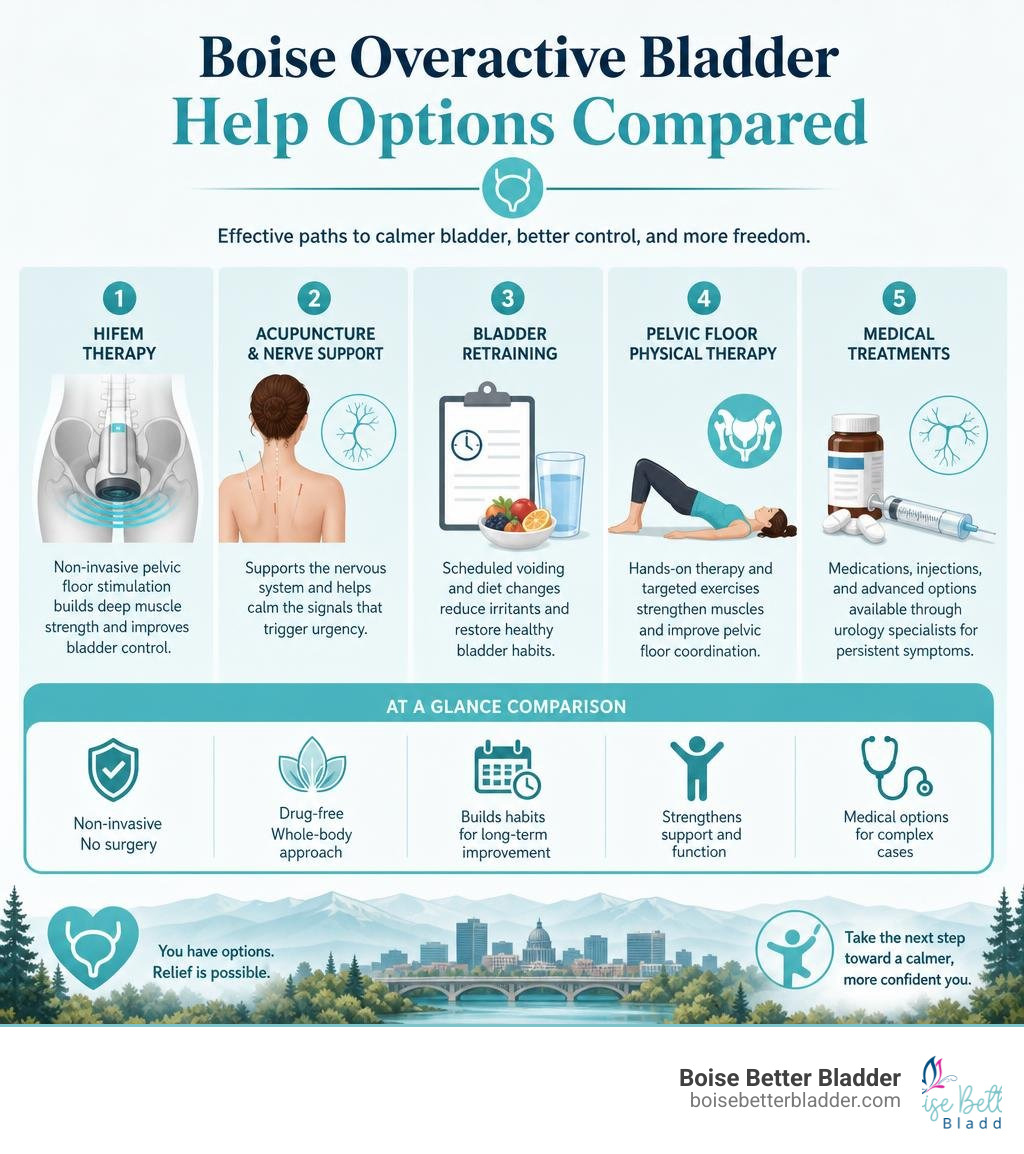
If you're searching for Boise overactive bladder help, here are the most effective options available in the Treasure Valley:
Non-invasive HIFEM therapy (Freedom+ pelvic floor stimulation) - rebuilds deep pelvic floor muscle strength without surgery or medication
Acupuncture and nerve pathway support - calms the nervous system signals that trigger urgent, uncontrolled bladder contractions
Bladder retraining and dietary changes - reduces irritants and helps restore normal voiding patterns
Pelvic floor physical therapy - guided muscle rehabilitation with a licensed specialist
Overactive bladder (OAB) is not something you simply have to accept. Yet many women in Boise have been told exactly that.
Your body isn't failing you. What you're experiencing - the sudden urgency, the leaks, the interrupted sleep, the constant planning around restroom locations - these are signals. They tell us that somewhere along the communication pathway between your brain, your nervous system, and your pelvic floor, something has become imbalanced.
More than 33 million people in the United States live with OAB. About one in three adults over 40 reports at least some symptoms. And yet, approximately 75% of women experiencing bladder leakage never discuss it with a healthcare provider - often because they've been made to feel it's just a normal part of aging. For a patient-friendly medical overview of bladder control symptoms and when to seek care, the National Institute of Diabetes and Digestive and Kidney Diseases offers additional educational guidance.
It isn't normal. And it isn't permanent.
Symptoms are signals. The body works in patterns. Understanding those patterns is the first step toward real, lasting relief.
I'm Dr. Kimberly Thompson, DACM, L.Ac., and I've spent years helping women in Boise find overactive bladder help that actually addresses the root cause - not just the symptoms. Through my work combining advanced HIFEM technology with acupuncture and integrative care, I've seen how much is possible when we stop managing the problem and start treating it.
Understanding the Root Causes of Bladder Urgency
To understand why your bladder is behaving this way, we have to look at the muscular and neurological patterns of the pelvis. The bladder is not just a passive balloon; it is wrapped in a powerful muscle called the detrusor.
In a balanced state, the detrusor muscle remains relaxed as the bladder fills, while the pelvic floor muscles stay engaged to keep the bladder neck closed. When you are ready to urinate, your brain sends a signal that tells the pelvic floor to relax and the detrusor muscle to contract, emptying the bladder.
In an overactive bladder pattern, this communication breaks down. The detrusor muscle begins to spasm or contract involuntarily before the bladder is actually full. This creates that sudden, overwhelming sensation of urgency—even if there are only a few drops of urine in your bladder.
When these involuntary contractions occur at night, they lead to a clinical condition known as nocturia. Waking up to urinate more than once per night is a significant disruptor of deep, restorative sleep. This chronic sleep fragmentation does more than make you tired; it impacts daytime cognitive function, alters your mood, and places constant stress on your nervous system.
Furthermore, hormonal transitions play a massive role in this equation. As women age or transition through menopause, estrogen levels naturally decline. Estrogen is vital for maintaining the thickness, elasticity, and blood flow of the pelvic tissues and the bladder lining. When estrogen levels drop, these tissues can become thin, dry, and easily irritated, which exacerbates both urgency and physical leaks. You can read more about this specific pattern in our guide on menopause bladder issues.
The Nervous System and Bladder Communication
The bladder and the brain are in constant communication. This pathway relies on a delicate balance between the sympathetic nervous system (which allows the bladder to fill and store urine) and the parasympathetic nervous system (which triggers the bladder to empty).
When the nervous system is locked in a state of chronic stress or hyper-reactivity, the bladder-brain feedback loop becomes hyperactive. The nerves surrounding the bladder begin sending premature "full" signals to the brain.
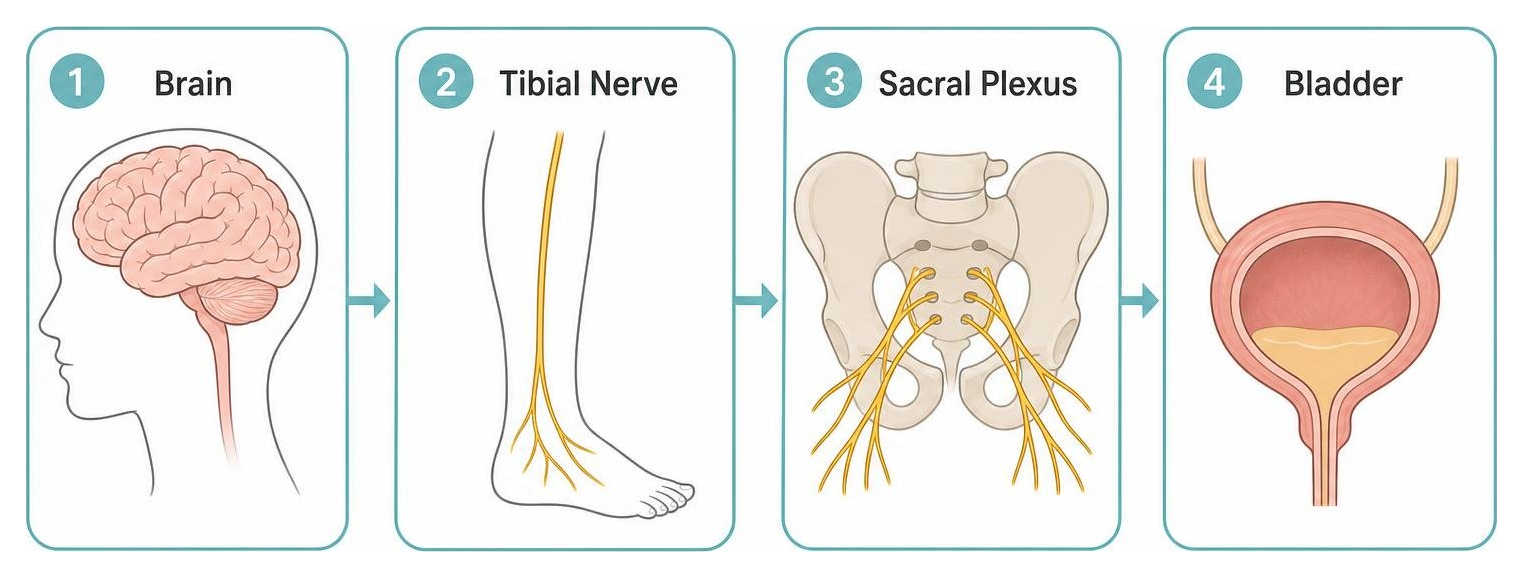
In our clinic, we recognize that the tibial nerve—which runs down the leg and passes near the ankle—shares a direct neurological pathway with the sacral nerve plexus, the very nerve center that controls bladder function. This is why targeting specific acupuncture points along the lower leg and ankle can be so profoundly effective. By stimulating these pathways, we can send calming signals back up to the sacral nerves, effectively "rebooting" the hyperactive communication loop and quietening the involuntary detrusor contractions.
How Muscle Weakness and Structural Shifts Affect Control
While the nervous system controls the timing, the physical structure of your pelvic floor provides the support. The levator ani muscle group acts as a supportive hammock for your bladder, uterus, and bowel.
When these muscles are strong and coordinated, they easily counteract internal physical pressure. However, pregnancy, vaginal childbirth, chronic constipation, and normal aging can stretch, weaken, or damage the levator ani. When this structural support system is compromised, the bladder neck can sag, making it much harder to maintain closure when you feel a sudden urge.
Many women are referred to standard pelvic physical therapy to address this weakness. While pelvic physical therapy is a highly valuable tool, some women find manual, internal physical therapy uncomfortable, invasive, or difficult to keep up with at home. For those looking for a different approach, modern, non-invasive alternatives can rebuild that vital structural support comfortably. You can explore how these paths compare in our detailed look at pelvic floor physical therapy boise.
Navigating Your Options for Boise Overactive Bladder Help
When you begin looking for Boise overactive bladder help, it is helpful to understand the spectrum of care available in the Treasure Valley. While some clinical settings focus on invasive procedures or long-term medications, many women prefer to explore conservative, non-surgical pathways first.

A highly effective starting point is bladder retraining combined with lifestyle and dietary adjustments. Bladder retraining helps teach your brain and bladder to communicate more predictably. By following a structured voiding schedule and gradually increasing the time between bathroom visits, you can train your detrusor muscle to tolerate larger volumes of urine without triggering an emergency response.
To support this process, we recommend identifying and minimizing common dietary bladder irritants. These substances can directly irritate the bladder lining, triggering sudden spasms:
Caffeine: A powerful diuretic and bladder stimulant found in coffee, tea, and soda.
Alcohol: Irritates the bladder tissue and interferes with brain-bladder signaling.
Acidic Foods and Drinks: Citrus fruits, tomatoes, and carbonated beverages can highly irritate a sensitive bladder.
Spicy Foods: Can trigger detrusor muscle spasms in sensitive individuals.
Artificial Sweeteners: Often act as chemical irritants to the urinary tract.
When to Seek Professional Boise Overactive Bladder Help
It can be difficult to know when bladder changes cross the line from a mild inconvenience to a medical concern requiring professional care. We encourage women to seek an evaluation when their symptoms begin to dictate their daily choices.
If you find yourself "bathroom mapping"—planning your travel routes, shopping trips, or social outings entirely around the availability of public restrooms—your bladder is running your life.
Other clinical thresholds that warrant professional care include:
Waking up more than once or twice a night to urinate, leading to chronic daytime fatigue.
Urinating more than 8 times in a 24-hour period.
Experiencing sudden, uncontrollable urges that result in leaks before you can reach a restroom.
Feeling constant anxiety about unexpected "uh-oh" moments during daily activities.
Holistic and Non-Invasive Boise Overactive Bladder Help
At Boise Better Bladder, we believe the most elegant and lasting solutions address both the muscular and neurological components of bladder control simultaneously. This is why we created a program that combines advanced High-Intensity Focused Electromagnetic (HIFEM) technology with holistic acupuncture.
Our program utilizes the FDA-cleared Freedom+ pelvic floor stimulation chair. This technology uses safe, MRI-like magnetic fields to stimulate and strengthen the deep pelvic floor muscles. While you sit fully clothed on the comfortable chair, the system delivers the equivalent of 25,000 supramaximal pelvic floor contractions in a single 30-minute session. This rapidly rebuilds the structural support of the levator ani muscle group without any active effort or discomfort on your part.
We pair this deep muscle re-education with targeted acupuncture. By utilizing specific meridian pathways, we help regulate the autonomic nervous system, improve local circulation, and calm the hyperactive nerve signals traveling between the bladder and the brain. This dual-system approach is designed to restore balance to your body's natural patterns, offering a comfortable alternative to surgical procedures or lifelong medications. You can learn more about this integrated approach in our article on overactive bladder treatment.
Stress Incontinence vs. Overactive Bladder: Recognizing the Patterns
It is very common for women to experience bladder leaks and assume they have an overactive bladder, when they may actually be dealing with stress urinary incontinence (SUI)—or a combination of both, known as mixed incontinence.
Because the body works in patterns, understanding the exact nature of your symptoms is crucial for choosing the right treatment pathway.
Feature | Stress Urinary Incontinence (SUI) | Overactive Bladder (OAB) / Urge Incontinence |
|---|---|---|
Primary Trigger | Physical pressure (coughing, laughing, sneezing, lifting, exercising) | A sudden, intense, and uncontrollable urge to urinate |
Underlying Mechanism | Weak pelvic floor muscles and structural support; bladder neck cannot stay closed under pressure | Hyperactive nerves; detrusor muscle spasms or contracts prematurely |
Timing of Leaks | Occurs immediately during physical exertion | Occurs shortly after a sudden rush of urgency, often when trying to reach the door |
Nighttime Urination | Typically rare, unless woken by a cough or physical movement | Common; frequently waking up multiple times to urinate (nocturia) |
Volume of Leakage | Often small to moderate dribbles | Can range from small leaks to complete bladder emptying |
Many women suffer from mixed patterns, experiencing physical leaks when they sneeze and sudden, urgent rushes when they pull into their driveway. Our non-invasive program is uniquely suited to address both patterns by simultaneously strengthening the physical muscular support and calming the overactive nervous system pathways.
Frequently Asked Questions About Bladder Control
We believe that education is a powerful form of medicine. Here are some of the most common questions we hear from women seeking Boise overactive bladder help.
What is the difference between OAB and stress incontinence?
The difference lies in the trigger and the mechanism. Stress incontinence is a structural issue: physical pressure (like a cough or jump) forces urine past a weakened pelvic floor. Overactive bladder is a neurological and muscular coordination issue: the bladder muscle itself contracts suddenly and prematurely, creating an intense urge that can lead to a leak before you reach the restroom.
How do acupuncture and HIFEM help calm an overactive bladder?
They address the two root causes of bladder dysfunction. Acupuncture regulates the nervous system, helping to calm the hyperactive brain-bladder communication loop and reduce involuntary detrusor muscle spasms. HIFEM technology (using our Freedom+ chair) delivers deep, involuntary contractions that rapidly rebuild the strength and coordination of the pelvic floor muscles, providing the physical support your bladder needs to stay closed.
What should I expect during a non-surgical bladder evaluation?
During your initial consultation, we will perform a comprehensive pattern analysis. We will sit down in a comfortable, supportive environment to review your complete health history, discuss your specific symptoms, and rule out any contraindications (such as pacemakers, copper IUDs, or pregnancy).

From there, we will design a customized, non-invasive care plan tailored specifically to your body's patterns and your lifestyle goals.
Reclaiming Your Balance and Freedom
Your body is not failing you; it is simply operating under an imbalanced pattern of communication and strength.
At Boise Better Bladder, we are proud to offer a compassionate, highly effective alternative to traditional surgery, lifetime medications, or uncomfortable physical therapy. Our signature program integrates advanced, FDA-cleared HIFEM technology with holistic acupuncture to help women across Boise, Meridian, Eagle, Nampa, and Caldwell regain complete bladder control.
Clinical studies show that 95% of participants using HIFEM pelvic floor therapy report a significant improvement in their quality of life, and two-thirds are able to completely eliminate or significantly reduce their use of urinary incontinence pads.
Our standard program consists of 8 to 9 comfortable, 30-minute sessions over a 4-week period. There is no downtime, no painful exercises, and no lifestyle disruption.
If you are ready to close the bathroom door on incontinence and reclaim your freedom to travel, exercise, and live without worry, we invite you to take the next simple step.
Learn more about how it works to see the science behind our program.
Ready to experience it for yourself? Book an appointment for a private consultation and a complimentary demo of our Freedom+ technology.
Have questions? Feel free to contact us directly.
Let us help you restore balance, strength, and confidence to your life. Visit us at Boise Better Bladder today.
