
The Hard Truth About Childbirth and Pelvic Floor Damage
What Childbirth Really Does to Your Pelvic Floor — and What You Can Do About It

Childbirth pelvic floor damage is one of the most common — and most under-discussed — consequences of vaginal delivery. If you've had children and are now experiencing leaks, pelvic pressure, or a sense that something "isn't right" down there, this guide is for you.
Quick answer — what you need to know:
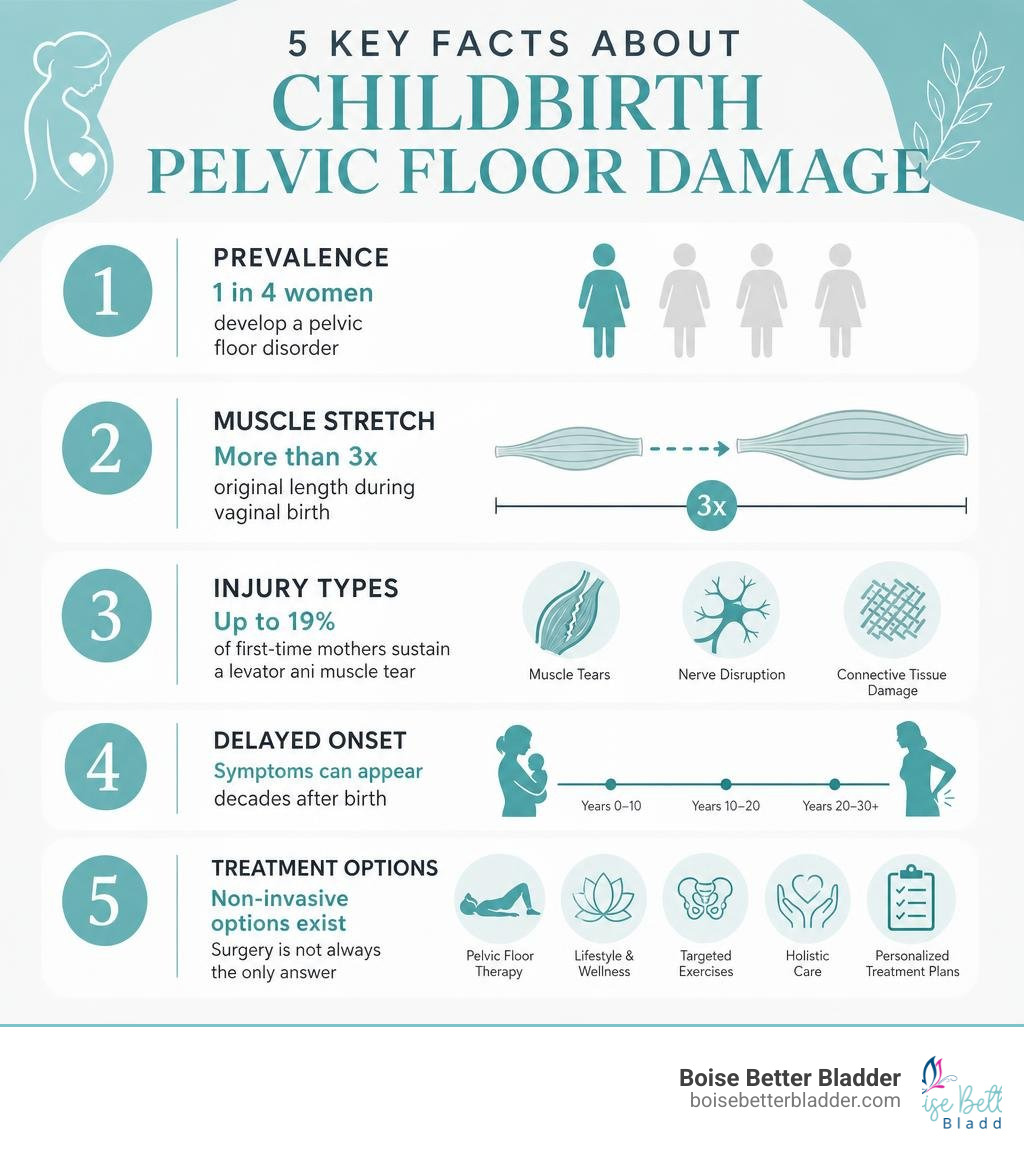
Key Fact What It Means for You 1 in 4 women develop a pelvic floor disorder It's far more common than most people realize Up to 19% of first-time mothers sustain a levator ani muscle tear Many injuries go undiagnosed for years Nearly 1 in 10 women eventually need surgery Most cases could be addressed earlier with the right care Symptoms can appear decades after birth A problem today may trace back to a delivery 20–30 years ago Non-invasive options exist Surgery is not always the only answer
Most women are told that some leaking or pelvic pressure after childbirth is just "part of the deal." It's common, yes — but it is not something you simply have to accept and live with.
Here's what actually happens: during vaginal birth, the levator ani muscle — the primary support structure of your pelvic organs — must stretch to more than three times its original length. That kind of force can cause microscopic tears, nerve disruption, and connective tissue damage that don't always show up as symptoms right away. Sometimes they surface years, or even decades, later.
Your body isn't failing you. These are signals worth paying attention to.
The good news is that understanding why this happens is the first step toward real recovery — at any age, and often without surgery.
I'm Dr. Kimberly Thompson, DACM, L.Ac., and over years of clinical practice I've worked with hundreds of women navigating the long-term effects of childbirth pelvic floor damage — many of whom had been dismissed or told their only option was surgery. In this guide, I'll walk you through exactly what happens to the pelvic floor during and after birth, what your symptoms may be telling you, and what evidence-based, non-invasive pathways toward recovery actually look like.
Understanding Childbirth Pelvic Floor Damage: Mechanisms and Prevalence
Many women believe pelvic floor issues are simply an inevitable consequence of getting older or carrying a baby. While pregnancy certainly places a physical load on the body, the typical explanation—that the pelvic floor just "gets weak" and needs basic exercises—is incomplete.
The pelvic floor is a complex, three-dimensional bowl of muscles, nerves, and connective tissue. When we look at the root causes of pelvic floor dysfunction, we see that vaginal childbirth can cause direct, structural trauma to these tissues. In fact, birth injury affects almost three times the number of people sustaining common knee sprains or anterior cruciate ligament (ACL) tears, yet it receives a fraction of the attention and rehabilitation support.
How Vaginal Birth Impacts the Levator Ani and Causes Childbirth Pelvic Floor Damage
The levator ani is the main muscular hammock supporting your bladder, uterus, and rectum. During the second stage of labor, this muscle must undergo extreme physical expansion. Biomechanical modeling shows that the levator ani stretches to more than three times its resting length (a stretch ratio of up to 3.26) to allow the baby to pass.
For many women, this tissue stretches and recovers beautifully. However, in up to 19% of first-time mothers, this intense stretching causes the levator ani muscle to tear away from the pubic bone—an injury known as a levator avulsion. When the muscle is detached from its bony anchor, it can no longer support the pelvic organs effectively.
To explore the deeper medical mechanisms behind this tissue strain, you can read the Scientific research on peripartum pelvic disorders and review the broader context of Scientific research on pelvic floor trauma.
Hidden Tears: Levator Avulsion and Anal Sphincter Injuries
Not all birth injuries are visible to the naked eye. While obstetricians routinely repair perineal tears and visible anal sphincter lacerations (which occur in about 3% of vaginal deliveries), levator ani avulsions are completely internal.
Because these muscle tears occur deep within the pelvis, they are often missed during standard postpartum checkups. A woman may leave the hospital believing her body has healed completely, unaware that the structural support of her pelvis has been altered. Over time, this hidden tissue trauma can lead to a gradual widening of the urogenital hiatus—the opening through which the urethra, vagina, and rectum pass.
Additionally, the extreme stretching of the birth canal can compress or overstretch the pudendal nerve, the primary nerve pathway supplying the pelvic floor. This nerve strain can temporarily or permanently disrupt the communication signals between your brain and your pelvic muscles, leading to hidden weakness and coordination issues.
For a deeper dive into how these hidden structural changes manifest over time, see the Scientific research on pelvic floor disorders following delivery.
The Pathways of Dysfunction: Short-Term and Long-Term Consequences
The body works in patterns. When the structural integrity of the pelvic floor is altered, it sets off a chain reaction affecting the bladder, support tissues, and nervous system. Symptoms are signals; they are your body's way of communicating that a pathway has been disrupted and needs support to find its way back to balance.
From Hiatal Enlargement to Pelvic Organ Prolapse
When the levator ani is injured or overstretched, the urogenital hiatus (the physical opening in the muscle bed) naturally enlarges. This hiatal enlargement is the single most important birth-related factor associated with pelvic organ prolapse later in life.
Data shows that a larger "straining hiatus" is directly linked to an increased risk of prolapse:
The 3.0-cm threshold: In the first 15 to 20 years after birth, approximately 25% of women with a straining hiatus of 3.0 cm or larger develop pelvic organ prolapse. The estimated median time to develop prolapse for these women is 33 years.
The 4.5-cm threshold: For women with a straining hiatus of 4.5 cm or larger, the likelihood of developing prolapse increases to over 60%, with a median development time of just 6 years.
This explains why a woman might feel perfectly fine in her 30s and 40s, only to experience a sudden sensation of pelvic heaviness or bulging in her 50s or 60s. The initial structural change occurred during childbirth, but the gradual descent of the organs took decades to become noticeable.
To understand the anatomical changes that occur during a first delivery, refer to the Scientific research on first vaginal birth anatomy.
Stress Incontinence and Nerve Denervation Postpartum
Another common pathway of dysfunction is stress urinary incontinence (SUI)—leaking urine when you cough, sneeze, laugh, or exercise. Stress incontinence occurs 2 to 3 times more often in women who deliver vaginally than in those who deliver via cesarean.
This isn't just about "weak muscles." The pelvic floor is made up of 70% slow-twitch (endurance) fibers and 30% fast-twitch (rapid-closure) fibers. During a difficult vaginal delivery, the nerves that tell the fast-twitch fibers to contract instantly during a sneeze can be stretched and damaged.
Research shows that women with persistent stress incontinence postpartum have a 25% lower maximal urethral closure pressure at rest and 31% greater bladder neck movement during a cough. If the nerves cannot communicate effectively with the muscles, the pelvic floor cannot react fast enough to prevent a leak.
For a detailed explanation of how these neural and muscular pathways function, you can read More info about how it works.
Identifying the Risk Factors: Delivery Methods and Maternal Variables
Every birth is unique, and pelvic floor damage is rarely caused by a single factor. Instead, it is the result of a pattern of variables coming together during labor. Understanding these risk factors allows us to assess individual patterns of risk and take proactive steps toward recovery.
Delivery Variable Pelvic Floor Injury Risk Level Primary Impact Spontaneous Vaginal Birth Baseline / Moderate Muscle stretching, potential minor tearing Vacuum-Assisted Delivery Moderately Elevated Increased tissue strain, lower avulsion risk than forceps Forceps-Assisted Delivery Highly Elevated Significant risk of levator ani avulsion and deep tears Cesarean Delivery (No Labor) Low Avoids mechanical birth canal trauma; pregnancy strain remains Cesarean Delivery (After Labor) Moderate Elevated risk due to labor progression and pelvic pressure
Forceps vs. Vacuum: The Impact of Operative Deliveries
When assistance is needed to deliver the baby, the choice of instrument plays a major role in pelvic health. Forceps-assisted delivery is the most critical modifiable risk factor for levator ani avulsion, increasing the risk 3.22-fold. The rigid metal blades of forceps place direct, high-force lateral pressure on the levator muscles as they are anchored to the pubic bone.
Vacuum extraction (ventouse), on the other hand, is associated with a significantly lower risk of deep muscle tearing. While it still increases tissue strain compared to a spontaneous birth, it allows the birth canal tissues to expand more naturally.
To learn more about clinical efforts to minimize these risks, see the Scientific research on preventable pelvic floor injury.
Maternal Age, Birthweight, and Labor Duration Patterns
In addition to the method of delivery, several maternal and fetal variables influence how well the pelvic tissues adapt during birth:
Maternal Age: As we age, our connective tissues naturally lose some of their elasticity. Research indicates that the risk of postpartum urinary incontinence increases by approximately 9% with each additional year of maternal age at first delivery.
Birthweight (Macrosomia): Delivering a baby weighing over 4,000 grams (8.8 pounds) or 4,500 grams significantly increases the mechanical stretch required of the pelvic floor, making tears more likely.
Prolonged Second Stage of Labor: Pushing for an extended period (especially over 2 hours) subjects the pelvic muscles and the pudendal nerve to prolonged compression, which can lead to nerve denervation and muscle fatigue.
Evidence-Based Prevention: Preparing the Body for Birth
Preparing the pelvic floor for birth is not about making it "stronger" through endless contractions; it is about teaching the muscles how to yield, soften, and release.
Prenatal Education and the Art of Pelvic Floor Relaxation
A common clinical misunderstanding is that a strong pelvic floor is a tight pelvic floor. In reality, tight, hypertonic muscles are more prone to tearing because they lack the flexibility to stretch.
Prenatal education should focus on coordination and breathwork. Traditional "purple pushing"—where a woman holds her breath and bears down with maximum force—creates intense intra-abdominal pressure and forces the baby against a contracted, tense pelvic floor. This increases the risk of severe tearing.
Instead, learning to coordinate the diaphragm with the pelvic floor allows the muscles to open and relax during contractions. Using controlled breathing and low-tone vocalizations helps facilitate this natural release.
To watch a helpful demonstration of these pelvic preparation patterns, view this Educational video on pregnancy and pelvic health.
Perineal Massage, Compresses, and Clinical Interventions
Several intrapartum techniques have been shown to reduce the risk of severe perineal tears:
Third-Trimester Perineal Massage: Regularly performing perineal massage starting around the 35th week of pregnancy helps increase tissue compliance and reduces the risk of obstetric anal sphincter injuries (OASI) by up to 31%.
Warm Compresses: Applying warm, moist compresses to the perineum during the second stage of labor increases local circulation, softening the tissues and allowing them to stretch more easily.
Manual Perineal Protection: Clinicians practicing controlled, slow delivery of the fetal head while supporting the perineum can significantly reduce the risk of deep lacerations.
Holistic Assessment and Natural Recovery Pathways
If you are already experiencing symptoms of childbirth pelvic floor damage, your body is sending you signals that it is out of balance. Recovery is entirely possible, and it begins with looking at the body as an interconnected system.
Early Recognition: Pattern Identification and Postpartum Assessment
In countries like France, postpartum pelvic physical therapy is standard care, with the government funding up to 10 rehabilitation sessions for every woman who gives birth. In the United States, however, women are often left to navigate these symptoms on their own.
Early recognition is key. A comprehensive postpartum assessment should look beyond basic muscle strength (the "squeeze" of a Kegel) to evaluate:
Muscle Tone and Coordination: Are the muscles constantly tight, or can they relax fully?
Nervous System Communication: Is the pudendal nerve sending clear signals to the pelvic floor?
Connective Tissue Integrity: Are there fascial restrictions, perhaps from a C-section scar or an episiotomy, that are pulling the pelvis out of alignment?
By identifying these patterns early, we can address the root cause of symptoms before they lead to long-term dysfunction.
Restoring Balance: Acupuncture, Nervous System Regulation, and Non-Invasive Restoration
At Boise Better Bladder, serving women throughout Boise, Meridian, Eagle, Nampa, and Caldwell, we take a holistic, non-invasive approach to pelvic restoration. We understand that the body works in patterns, and true healing requires addressing both the physical muscles and the nervous system pathways that control them.
Our signature program combines advanced, FDA-cleared High-Intensity Focused Electromagnetic (HIFEM) technology with traditional acupuncture techniques:
HIFEM Technology: This comfortable, non-invasive therapy sits you fully clothed on a specialized chair that delivers electromagnetic pulses to the pelvic floor. A single 30-minute session triggers the equivalent of 25,000 deep pelvic floor contractions, rebuilding muscle strength, endurance, and coordination far more effectively than traditional exercises can.
Acupuncture and Nervous System Regulation: We pair this mechanical strengthening with acupuncture to calm the nervous system, improve local circulation, and restore proper nerve communication to the pelvic tissues. This dual approach addresses the root cause of bladder leaks, urgency, and pelvic pressure.
Your body isn't failing you; it simply needs the right inputs to restore its natural pathways of support and communication.
To read stories from women in the Treasure Valley who have restored their pelvic health through this integrated approach, visit More info about our testimonials.
Frequently Asked Questions About Pelvic Injury
Can a C-section completely prevent pelvic floor damage?
While a cesarean delivery avoids the direct mechanical stretching and tearing of the birth canal, it does not completely eliminate the risk of pelvic floor disorders.
Pregnancy itself is an independent risk factor. For nine months, the pelvic floor must carry the weight of the growing baby, uterus, and placenta. Additionally, the hormone relaxin softens the ligaments and connective tissues throughout the body, reducing pelvic stability regardless of how you deliver. Furthermore, if a woman experiences labor and pushes before undergoing an emergency C-section, the pelvic tissues have already experienced significant pressure and strain.
How long does it take for the pelvic floor to recover after birth?
For most women, initial muscle strength begins to return within 2 to 6 weeks postpartum, and acute nerve irritation (such as temporary numbness or weakness) often improves within 2 months.
However, complete structural and tissue remodeling can take up to a year or longer. If a deep muscle tear (like a levator avulsion) has occurred, the body will adapt by using surrounding muscles to compensate. If you are still experiencing symptoms like leaking or heaviness six months after delivery, it is a sign that the pelvic floor requires targeted support to fully recover.
What are the early warning signs of a pelvic floor injury?
Symptoms are signals. Some of the most common early signs that your pelvic floor needs attention include:
Occasional bladder leaks when coughing, sneezing, laughing, or running.
A persistent feeling of heaviness, pressure, or pulling in the pelvis, especially at the end of the day.
Difficulty fully emptying your bladder or bowel.
Pain or a lack of sensation during intimacy.
Lower back or pelvic girdle pain that doesn't seem to resolve with rest.
Conclusion
Childbirth pelvic floor damage is a deeply personal and common challenge, but it is not a life sentence. Whether you gave birth six months ago in Meridian or thirty years ago in Boise, your body has an incredible capacity to heal and find its way back to balance when given the proper support.
At Boise Better Bladder, we are committed to helping women across the Treasure Valley regain control, confidence, and comfort without surgery, medications, or invasive physical therapy. By combining modern muscle-strengthening technology with time-tested holistic medicine, we address the root cause of your symptoms so you can get back to living your life fully.
If you are ready to listen to your body's signals and take a gentle, effective step toward recovery, we invite you to Schedule a consultation today.
