
Can Needles Help Your Bladder? Acupuncture Explained
When Your Body Is Sending Signals You Can No Longer Ignore

Acupuncture for pelvic floor dysfunction is a clinically studied, non-invasive treatment that helps restore muscle tone, nerve communication, and bladder control — often where other approaches have fallen short.
Can acupuncture help pelvic floor problems? Here's a quick summary:
Condition What Acupuncture Can Do Urinary incontinence Reduces leakage; electroacupuncture shown superior to sham in clinical trials Chronic pelvic pain Reduces inflammation and muscle tension Postpartum recovery Supports pelvic floor muscle strength when combined with Kegel exercises Overactive bladder Helps regulate bladder urgency via nervous system modulation Sexual dysfunction Improves circulation and reduces pelvic guarding
You've probably been told that bladder leaks are just part of getting older. Or that Kegels will fix it. Or maybe that surgery is your only real option.
None of that has to be the whole story.
The pelvic floor is not just a group of muscles. It's a complex pressure system — connected to your nervous system, your hormones, your diaphragm, and your hips. When something goes wrong, your body isn't failing you. It's communicating.
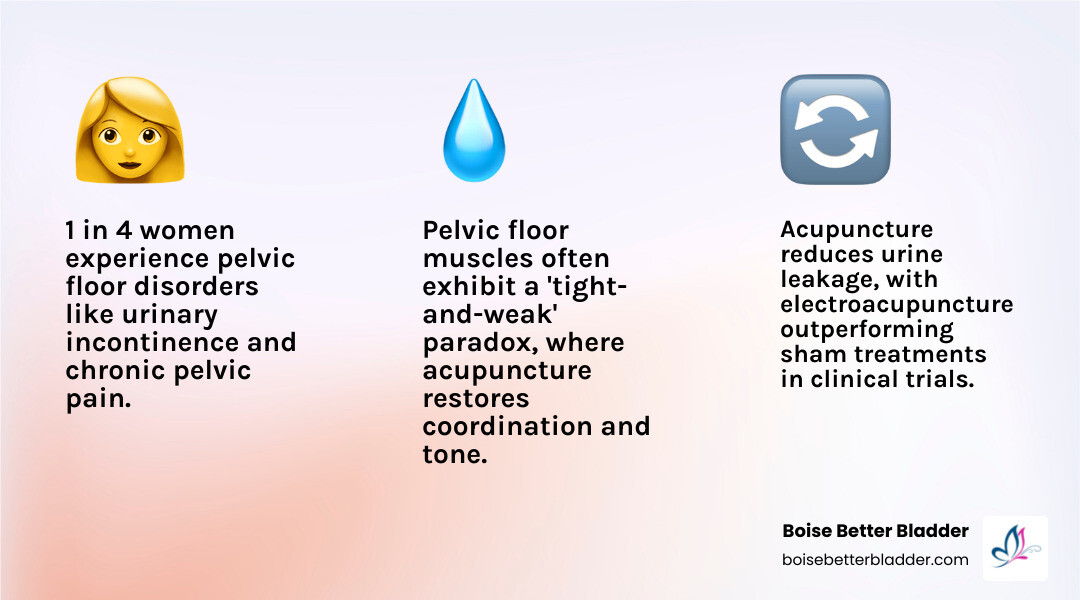
And nearly 1 in 4 women live with pelvic floor disorders — including urinary incontinence, chronic pelvic pain, and pelvic organ prolapse — many of them quietly managing symptoms they were told to accept.
Traditional Chinese Medicine, and acupuncture in particular, offers a different lens. Rather than chasing symptoms, it looks for the pattern underneath — and works to restore the body's own communication pathways.
I'm Dr. Kimberly Thompson, DACM, L.Ac., and I've spent my career working with women whose pelvic floor symptoms weren't fully resolved by conventional care — bringing acupuncture for pelvic floor dysfunction into an integrative, results-focused approach at Boise Better Bladder. In this guide, I'll walk you through exactly how and why this works, what the research shows, and what you can realistically expect.
Understanding the Patterns of Pelvic Floor Dysfunction
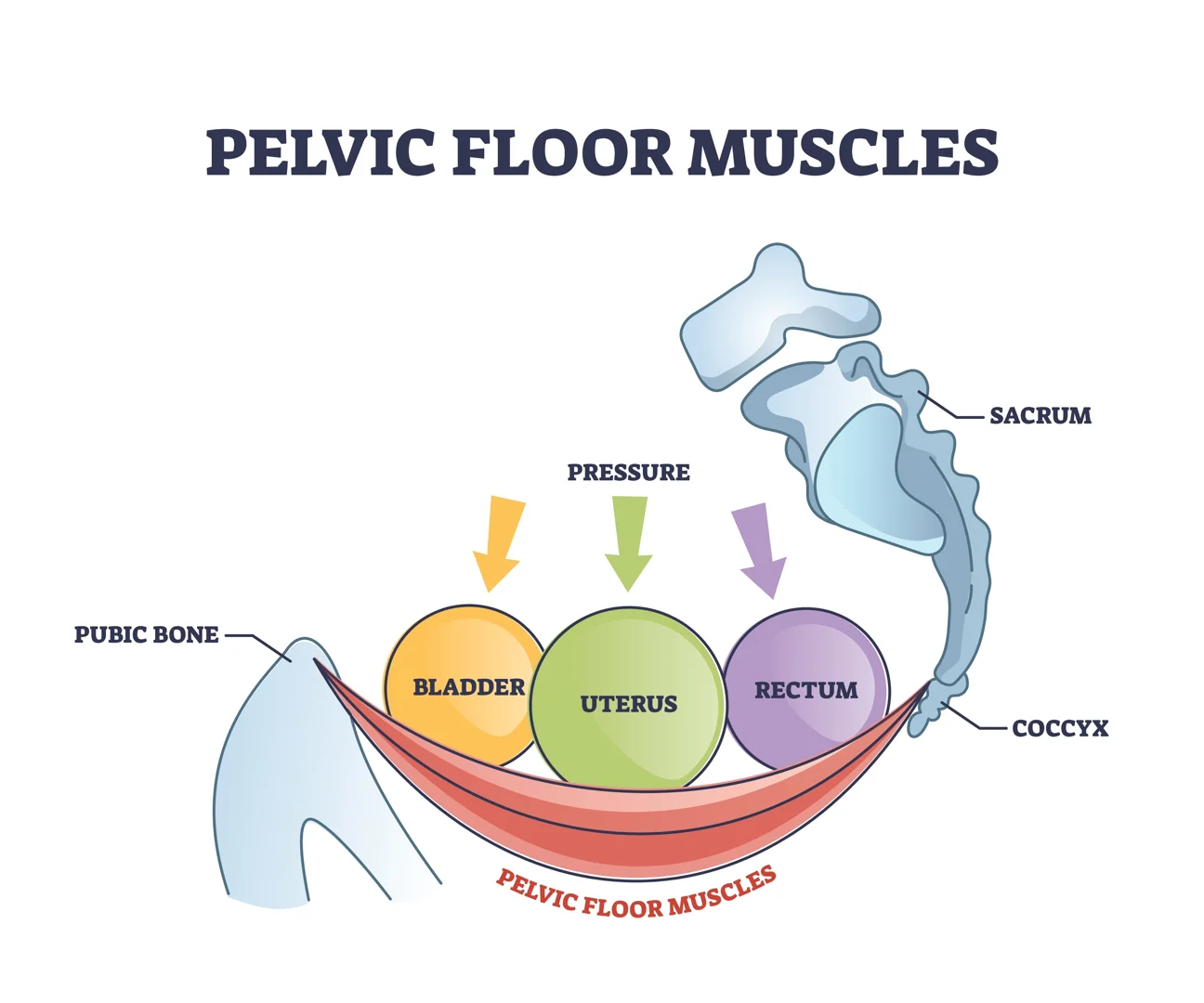
In my clinical practice, I often remind patients that the body works in patterns. When we look at the pelvic floor, we aren't just looking at a "hammock" of muscles; we are looking at a vital intersection of the structural and the energetic.
As of April 2026, the data remains clear: pelvic floor disorders are incredibly common but remain vastly under-diagnosed. Statistics show that roughly one-quarter of women in the U.S. are affected by these issues. Whether it is chronic pelvic pain, urinary incontinence, or pelvic organ prolapse, these conditions significantly impact quality of life.
For many women, the journey begins after childbirth. In fact, 50% of women postpartum experience pelvic floor issues, ranging from tailbone injuries to scarring from episiotomies or tearing. These physical traumas create "noise" in the body's communication system. Scientific research on acupuncture for pelvic disorders suggests that acupuncture can help clear this noise, addressing the root imbalances rather than just the surface-level symptoms.
Common Symptoms and Signals
Symptoms are signals. They are your body’s way of asking for a change in the current state of affairs. In our Boise and Meridian clinics, we see women presenting with a variety of signals, including:
Bladder Urgency: That sudden, overwhelming "must-go" feeling.
Urinary or Fecal Incontinence: Involuntary leakage during exercise, sneezing, or coughing.
Painful Intercourse: Discomfort that often stems from hypertonic (overly tight) pelvic muscles.
Pelvic Heaviness: A sensation of pressure often associated with organ prolapse.
Lower Back Pain: Because the pelvic floor is connected to the spine and hips, dysfunction here often manifests as chronic back or sacroiliac (SI) joint pain.
If you are experiencing these, more info about our approach can help you understand how we view these symptoms as part of a larger clinical picture.
Root Causes and Risk Factors
Why does the pelvic floor lose its rhythm? The causes are often multifactorial. Vaginal delivery is a primary factor, as the physical stretching and potential nerve damage can disrupt muscle coordination. However, aging and hormonal shifts play equally large roles.
Estrogen deficiency during menopause can lead to thinning of the pelvic tissues and a loss of elasticity. Chronic constipation, which leads to repetitive straining, increases intra-abdominal pressure that eventually weakens the pelvic support structure. Obesity and chronic coughing also contribute to this "pressure system" failure.
The body works in patterns. If the pressure from above (the diaphragm) and the support from below (the pelvic floor) are out of sync, the system begins to leak—sometimes literally.
How Acupuncture for Pelvic Floor Restores Communication
%20(1)%20(1)_compressed.webp?alt=media&token=e2f2a58b-1d4d-4338-93ca-a20d9320e3dc "Acupuncture needle placement focused on pelvic health points - Acupuncture for pelvic floor")
Many patients ask, "How can a needle in my leg or back help my bladder?" The answer lies in the nervous system. Acupuncture for pelvic floor works by modulating the signals sent between the brain and the pelvic organs.
When we insert a needle, we are initiating a biological conversation. This process triggers the release of neurotransmitters and anti-inflammatory cytokines that help reduce muscle tension and improve blood flow to the pelvic region. By regulating the autonomic nervous system, we can move the body out of a "fight or flight" state—which often causes pelvic guarding—and into a state of "rest and digest," where healing occurs.
You can learn more about how the process works on our dedicated page, but the core principle is simple: we are restoring the body's natural ability to coordinate muscle contraction and relaxation.
Addressing Hypertonic vs. Hypotonic Patterns
Your body isn’t failing you; sometimes it is just trying too hard. We categorize pelvic floor dysfunction into two main patterns:
Hypertonic (Overactive): The muscles are stuck in a state of "guarding" or tension. This often causes pain, urgency, and the "tight-and-weak" paradox, where a muscle is too exhausted from holding tension to actually perform its job.
Hypotonic (Underactive): The muscles have lost their tone and "spring," leading to prolapse and stress incontinence.
Acupuncture is an adaptogen for the muscles. For hypertonic patients, we focus on "de-guarding"—using points to signal the nervous system to let go. For hypotonic patients, we use motor point activation to "wake up" the muscles and improve their responsiveness.
The Role of Specific Acupoints
We select points based on their anatomical and energetic significance.
Zhibian (BL54): Located on the Bladder Meridian, this point is deep in the gluteal region. Research shows that stimulating this area can influence the perineal nerves, which are responsible for pelvic floor strength and urinary control.
Zhongji (CV3): Known as the "Mu Point" of the bladder, this is a central hub for regulating urinary function. It is a meeting point for several meridians that govern the lower abdomen.
Sacral Points: These points target the sacral plexus, the nerve bundle that controls the bladder and bowel.
Clinical Evidence: Acupuncture for Pelvic Floor and Urinary Health
The scientific community has taken a deep interest in these traditional techniques. Recent meta-analyses have provided robust data on the efficacy of these treatments.
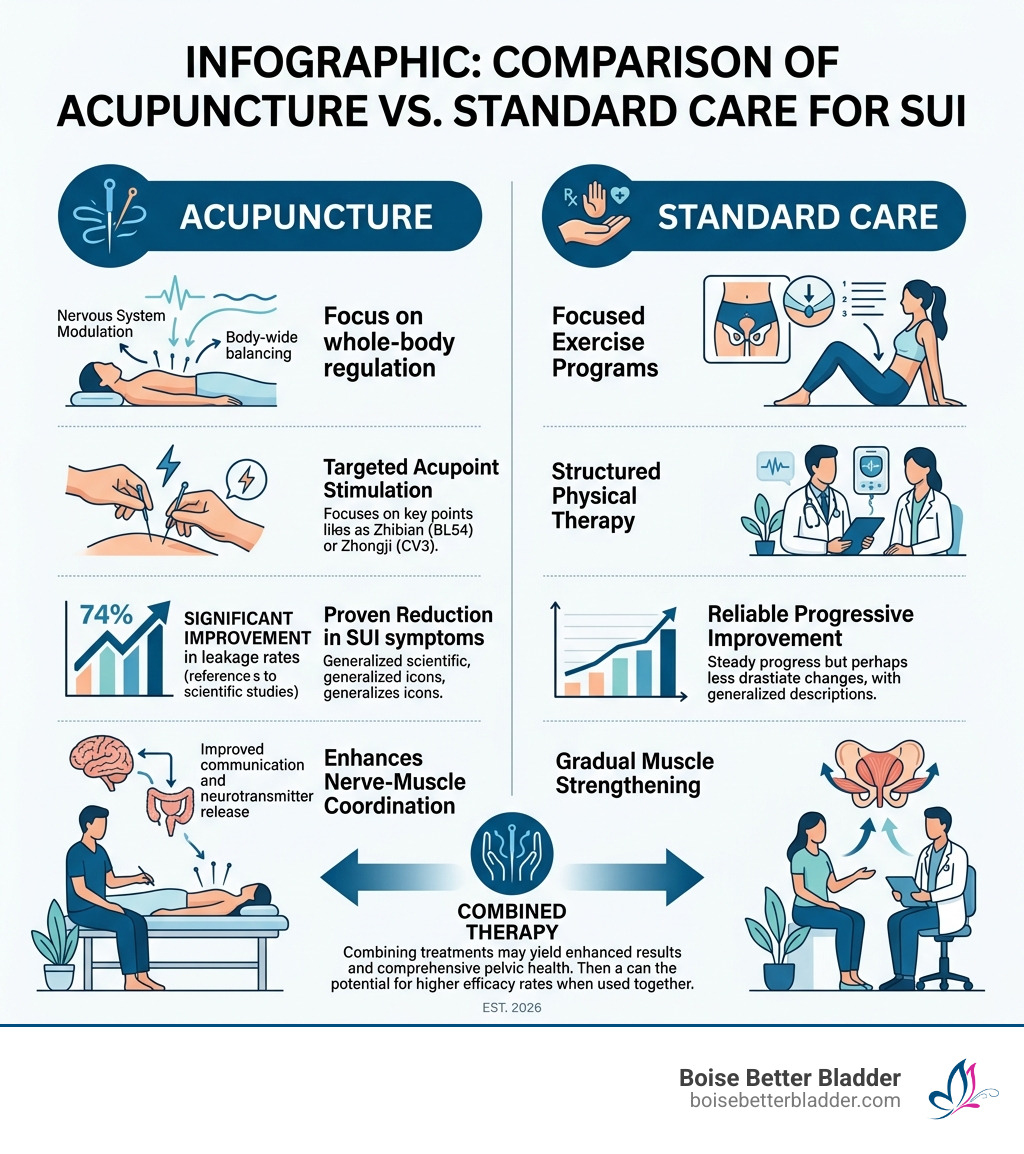
A significant meta-analysis on acupuncture for stress urinary incontinence showed that electroacupuncture (EA) significantly improves urine leakage. In studies using the International Consultation on Incontinence Questionnaire-Short Form (ICIQ-SF), patients receiving acupuncture showed marked improvements in their scores compared to those receiving sham treatments.
Furthermore, a scientific study on warm acupuncture and Kegels found that combining these therapies led to a 93.75% effective rate for treating urinary incontinence in postpartum women.
Research on Stress Urinary Incontinence (SUI)
Stress Urinary Incontinence (SUI) affects approximately 27.6% of women globally. It is characterized by leakage during physical exertion. Clinical trials have repeatedly shown that acupuncture is "non-inferior" to conventional conservative treatments like pelvic floor muscle training (PFMT) alone, and often superior when the two are combined.
In one-hour pad tests—a standard measure of leakage—acupuncture has been shown to reduce urine loss by an average of 4.69g more than sham treatments. This isn't just a subjective feeling of improvement; it is a measurable change in the body’s ability to hold tension. To see how this translates to real life, you can read patient testimonials from those who have regained their confidence.
Structural Changes and Imaging
Perhaps the most fascinating research involves transperineal ultrasound (TPUS). This technology allows us to see the immediate structural effects of acupuncture. Studies focusing on the Zhongji point have shown measurable changes in:
Bladder Neck Descent (BND): Reduced descent indicates better support.
Urethral Rotation Angle (URA): Improvements here suggest better urethral stability.
Retrovesical Angle (RVA): A key indicator of anatomical recovery from cystocele (bladder prolapse).
These findings suggest that acupuncture does more than just "relax" the patient; it facilitates a physical reconfiguration of the pelvic support structures.
Integrating Acupuncture for Pelvic Floor with Modern Rehabilitation
At Boise Better Bladder, we don't believe in "either/or" medicine. We believe in "and." While acupuncture is powerful, it is most effective when integrated into a comprehensive framework.
Our typical framework lasts 6 to 12 weeks. We combine the neurological benefits of acupuncture with the muscle-building power of modern technology. For those in Nampa, Caldwell, or Eagle, this means a localized, high-touch approach to healing. If you're ready to explore this, please contact us for a consultation.
Beyond Standalone Treatment
Acupuncture acts as a catalyst. For many women, pelvic floor physical therapy can be difficult because the muscles are too painful or too "locked" to train. Acupuncture helps "unlock" these muscles, making exercises like Kegels much more effective.
We also focus on:
Diaphragmatic Breathing: Retraining the "top" of the pressure system.
Lifestyle Adjustments: Identifying bladder irritants like caffeine or managing chronic constipation.
Compliance: It is much easier to stick to a routine when you start seeing results quickly.
If you are ready to start your journey, you can book an appointment online today.
Safety and Clinical Outcomes
One of the greatest benefits of acupuncture for pelvic floor is its safety profile. Unlike medications which may cause dry mouth or constipation, or surgeries which require significant downtime, acupuncture has minimal side effects—occasionally minor bruising or a temporary sensation of heaviness at the needle site.
It is a particularly excellent option for "refractory" cases—those who have tried everything else without success. For our postpartum patients, we typically recommend an evaluation around 42 days after delivery to begin the restoration process.
Frequently Asked Questions about Pelvic Health
How many sessions are typically needed for results?
While every body is different, the patterns of healing usually emerge within 6 to 12 sessions. Most patients begin to notice a change in urgency or leakage frequency within the first 3 to 4 weeks.
Is pelvic floor acupuncture painful?
No. We use ultra-fine, sterile needles. Most patients find the sessions deeply relaxing, often falling into what we call an "acu-nap." While you may feel a dull ache or a "heavy" sensation (known as De Qi), it should not be painful.
Can acupuncture help if physical therapy didn't work?
Yes. Often, physical therapy "fails" because the nervous system is too overstimulated or the muscles are too hypertonic to respond to strengthening. Acupuncture addresses the underlying neurological "noise," allowing the muscles to finally receive the signals the physical therapist is trying to send.
Conclusion
At Boise Better Bladder, we understand that your pelvic health is the foundation of your confidence and freedom. Your body isn't failing you; it's simply out of balance. By combining the ancient wisdom of acupuncture for pelvic floor with modern, FDA-cleared HIFEM technology, we offer a path to restoration that is gentle, non-invasive, and backed by science.
Whether you are in Boise, Meridian, Eagle, Nampa, or Caldwell, our goal is to help you stop managing symptoms and start living your life again. The body works in patterns, and we are here to help you find a healthier one.
To learn more or to schedule your evaluation, visit us at https://boisebetterbladder.com.
